
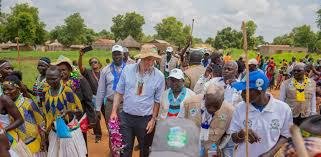
A delegation comprising officials from the Government of South Sudan and the World Bank Group has lauded the positive progress made under the Shabaka Meisha Project during a visit to implementation sites in Torit County, Eastern Equatoria State.
Shabaka Meisha Project is officially known as the Productive Safety Net for Socioeconomic Opportunities Project (SNSOP).
The project is designed to uplift vulnerable households through labor-intensive public works and direct income support.
The delegation was led by Hon. Esther Ikere, Undersecretary at the Ministry of Gender, Child and Social Welfare; Charles Undeland, Country Manager for the World Bank Group in South Sudan; Mukulish Arafat Simeonah Mule, Shabaka Meisha Task Team Leader; and Petronella Halwiindi, UNOPS Country Manager in South Sudan.
They were joined by Hon. Peter Gumbo, Minister of Parliamentary and Legal Affairs, representing the Governor of Eastern Equatoria, along with officials from the Single Project Coordination Unit (SPCU) and UNOPS, which is implementing Component 1 of the project.
Funded by the World Bank to the tune of US$199 million, the four-year project targets 157,500 vulnerable households across 20 counties, promoting food security, rebuilding livelihoods, and offering economic opportunities to youth.
It also aims to strengthen South Sudan’s social protection systems and institutional capacities.
During the field visit, the delegation observed biometric cash transfers and labor-intensive activities such as road rehabilitation and climate-smart agricultural projects.
Beneficiaries had the opportunity to share their experiences, giving delegates direct insights into the project’s impact.
Hon. Esther Ikere highlighted the significance of social safety nets in post-conflict recovery.
“As a nation emerging from conflict, social safety nets are essential to building the resilience of vulnerable households, especially those headed by single mothers, children, and the elderly,” she said.
Rev. Taban Elunai, Director of Agriculture Extension in the Ministry of Agriculture and Food Security, described the project as “timely and transformative,” adding that it supports national objectives to improve food security, generate employment, and empower citizens.
For his part the World Bank Country Manager Charles Undelandpraised the government’s leadership in implementing the program.
“Shabaka Meisha is not only delivering much-needed support to vulnerable communities and households, but it also demonstrates the importance of government ownership in delivering social services,” he said.
Undeland added that the World Bank remains committed to supporting South Sudan in building a strong social protection system that empowers its people and supports sustainable development.
The visit reaffirmed the shared commitment of national and international partners to promoting transparency, accountability, and learning in the implementation of large-scale social protection initiatives across the country.