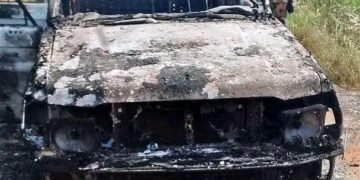



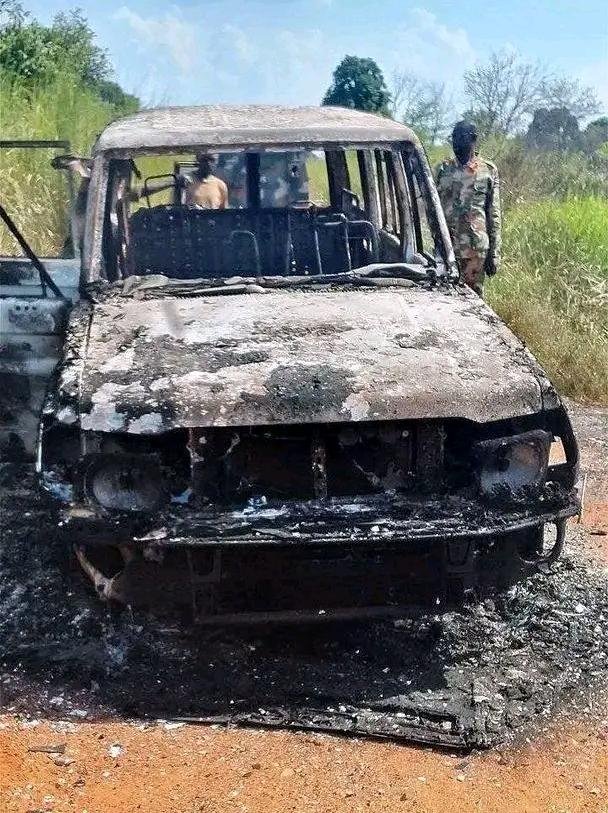
Security forces in Mundri West County are searching for two police officers who went missing after armed men attacked and completely burned a government vehicle that was transporting a sick patient to a health facility, in the latest incident to raise concerns over insecurity along Western Equatoria’s major roads.
The attack occurred on Sunday, according to Western Equatoria State Police Commissioner Maj. Gen. Bringi Justin. The vehicle belonged to the Mundri West County Commissioner and was reportedly being used to transport a patient to Bari village when it came under attack.
The vehicle was burned beyond repair, while the two police officers accompanying it went missing during the incident. Authorities have not confirmed whether the officers were abducted, killed or are being held by the attackers, and their whereabouts remain unknown.
“The vehicle was burnt totally. Our personnel are still searching for the two missing police personnel, and the rest of the forces returned safely to Mundri,” Maj. Gen. Bringi said.
The incident has intensified fears among residents, travellers and local authorities over the safety of people using the Juba–Mundri–Yambio corridor, which has experienced a series of armed attacks this year.
The latest incident is particularly concerning because the vehicle was reportedly engaged in a humanitarian and public-service role, transporting a sick person to a health centre.
The burning of the vehicle has raised questions about the growing risks facing government officials, health-related movements and ordinary civilians travelling on roads linking Western Equatoria with the national capital.
The disappearance of the two police officers has also added a serious security dimension to the incident, with authorities continuing efforts to establish their whereabouts.
No group has publicly claimed responsibility for the attack, and the identities and motives of the assailants have not been established.
The Mundri incident comes only weeks after a series of attacks along the same broader road network.
On August 3, two mourners were killed and four others injured when unidentified armed men ambushed a vehicle travelling along the Mundri–Juba Road between Doroh and Buägyi in Mundri East County. The victims were reportedly returning to Juba after attending a burial.
Just days later, on August 7, a humanitarian convoy travelling through Mundri East was attacked, with one Norwegian Refugee Council truck reportedly set ablaze. The two drivers escaped unharmed, according to local authorities.
In May, a civilian travelling in a timber transport convoy on the Juba–Yambio road was killed in an ambush. The attack occurred between Jambo and Lui, according to authorities and the victim’s relatives.
The attacks have added to a longer record of insecurity affecting the transport corridor.
In July 2025, one woman was killed and two men injured when a passenger vehicle travelling from Mundri towards Juba was ambushed near Lui.
A month later, a humanitarian truck travelling on the Yambio–Juba route was also ambushed in Mundri East, leaving its driver with a gunshot wound.
And in September 2022, three trucks travelling along the Mundri road came under attack, with one driver killed and vehicles burned, according to police and county authorities.
The repeated incidents have turned sections of the corridor into a persistent security concern for passengers, traders, humanitarian agencies and government officials.
The latest attack also highlights a troubling history of violence involving vehicles belonging to county authorities in Western Equatoria.
In July 2021, during deadly violence in Tombura County, a vehicle belonging to then-Tombura County Commissioner Mathew Mabenge was reportedly set on fire after it broke down near Tombura. The incident occurred amid broader clashes and insecurity in the county.
The pattern demonstrates that county officials and government vehicles are not necessarily insulated from the insecurity affecting ordinary road users.
Elsewhere in South Sudan, government officials have also faced attacks while travelling. In June this year, the Commissioner of Kapoeta East County was reported to have been ambushed while travelling towards Kessengor, although authorities at the time were still verifying the circumstances and his fate.
These incidents underscore the wider security challenges confronting local administrators who must travel between county headquarters and remote communities to deliver government services.
For residents of Western Equatoria, the attacks have implications beyond personal safety.
Major roads connecting Juba, Mundri, Maridi, Yambio and other parts of the state are essential for the movement of food, medicines, passengers, government officials and humanitarian supplies.
When vehicles are attacked or travellers fear using the roads, the consequences can include delays in the delivery of essential services, higher transportation costs and disruption to local trade.
Humanitarian organisations have also repeatedly faced security challenges on the routes.
The August attack on the NRC convoy, for example, occurred while humanitarian supplies were being transported to communities in need.
For health services, the latest incident is particularly troubling because the vehicle was reportedly transporting a sick patient. If people cannot safely travel to health facilities, access to urgent medical care can become even more difficult in rural areas.
The repeated attacks have renewed calls for security forces to increase patrols along vulnerable sections of the highways and for authorities to identify and apprehend those responsible.
Community leaders and officials have previously urged the government to improve security on the roads and restore confidence among travellers.
The challenge is complicated by uncertainty over who is behind individual attacks. In previous incidents, authorities have referred to unidentified gunmen, armed groups or criminal elements, while stressing that investigations are necessary before assigning responsibility.
This distinction is important because authorities need to determine whether the attacks are primarily criminal road robberies, politically motivated violence, or involve organised armed groups.
The security situation also comes at a sensitive moment for South Sudan, which is preparing for its planned December 22, 2026 general elections.
The safety of roads will be important not only for ordinary citizens but also for election officials, political actors, observers, security personnel and voters who may need to travel between communities.
Persistent insecurity on major transport routes could complicate political mobilisation, the movement of election materials and public participation, particularly in rural areas.
For Western Equatoria, where many communities are geographically separated and rely heavily on road transport, restoring confidence on the highways could therefore have implications extending beyond immediate security concerns.
For now, the immediate priority for authorities remains locating the two police officers who disappeared during Sunday’s attack.
Their families and colleagues are awaiting information as security forces continue searching the area.
The burning of a county government vehicle is also a reminder of the risks faced by officials attempting to provide services outside urban centres.
The incident has once again placed a familiar question before Western Equatoria authorities: how can government guarantee the safety of civilians, health workers, traders and officials on roads that remain essential to the state’s economic and social life?
Until those responsible for repeated attacks are brought to justice and vulnerable road sections are secured, the fear of ambushes is likely to continue weighing heavily on travellers and communities across Western Equatoria.