
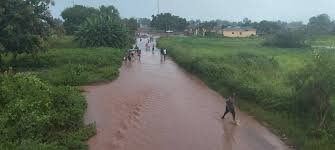
In the heart of Western Equatoria State, thousands of families in Greater Yeri Payam of Mvolo County are clinging to survival after catastrophic floods swept through the area, leaving homes under water, farms destroyed, and children without schools.
Mvolo County Commissioner, Hon. Ruben Amaai, who returned to the county this week after official duties in Juba and Yambio, broke down the extent of the destruction during a press briefing Thursday, describing the situation as a “humanitarian crisis beyond the capacity of the county.”
“The situation in Greater Yeri is dire. Families are sleeping in the open, schools and churches are submerged, and livelihoods have been swept away. Our people are in urgent need of food, shelter, blankets, plastic sheets, and mosquito nets. Without immediate intervention, this crisis will worsen,” Amaai said.
Homes, Churches, and Even Leadership Residences Lost
The floods, triggered by heavy and prolonged rainfall since August, have displaced entire villages. Among the destroyed properties are the official residence of the County Commissioner himself and the Bishop of Yeri Diocese.
Farmlands that once promised a harvest now lie under stagnant water, raising fears of acute hunger in the months ahead.
For residents like Martha Ladu, a mother of six, survival has become a daily struggle.
“We sleep outside with our children because the water took everything. The mosquito bites are unbearable, and we have no food left. My children cry every night asking for something to eat,” she told local journalists.
Her story mirrors thousands of others. Community leaders warn that unless aid is delivered immediately, disease outbreaks such as malaria and diarrhea could spread rapidly among the displaced.
As if the floods were not enough, Mvolo County is also grappling with intercommunal clashes in Wowo, further stretching resources and increasing the displacement of civilians.
“We are facing two battles at once—nature on one side, and violence on the other. As Commissioner, I am determined to coordinate with state and national authorities, alongside humanitarian agencies, to ensure that peace and relief reach our people,” Amaai affirmed.
The twin crises have deepened the vulnerability of the county’s most fragile groups—women, children, the elderly, and people with disabilities.
Amaai praised the early efforts of the Relief and Rehabilitation Commission (RRC), community-based organizations, and individuals who stepped in with immediate support. But he stressed that local efforts are overwhelmed.
“This is not just a local problem. It is a humanitarian emergency. I call on our state, our nation, and our international partners to stand with Mvolo. Together, we must rescue our people,” he appealed.
Children are bearing the heaviest brunt of the crisis. Schools in flooded areas have either been destroyed or turned into shelters for displaced families. Teachers warn that unless alternative learning spaces are arranged, thousands of children risk losing an entire academic year.
James, a 12-year-old pupil in Yeri, put it simply citing that.
“We want to go back to school. We don’t want to stay at home forever.”
Humanitarian agencies say that an urgent response is needed, including: Emergency food supplies, Shelter materials (plastic sheets, blankets, mosquito nets).
Health interventions to prevent disease outbreaks and Longer-term recovery support for farmers to replant and rebuild their livelihoods.
Community elders, church leaders, and youth representatives who witnessed the press statement echoed the Commissioner’s call, describing the crisis as “a test of solidarity for the people of Western Equatoria and South Sudan at large.”
For the people of Greater Yeri, the crisis is more than statistics—it is about survival. Displaced families continue to wait, hoping their cry will be heard beyond Mvolo County.
“If we don’t get help soon, many will die—not from bullets, but from hunger, cold, and disease,” said elder Joseph Mawa, whose home was swept away.
As Mvolo struggles to stay afloat in the wake of floods and violence, all eyes are now on the State Government, the National Government, and humanitarian agencies to answer that cry.