
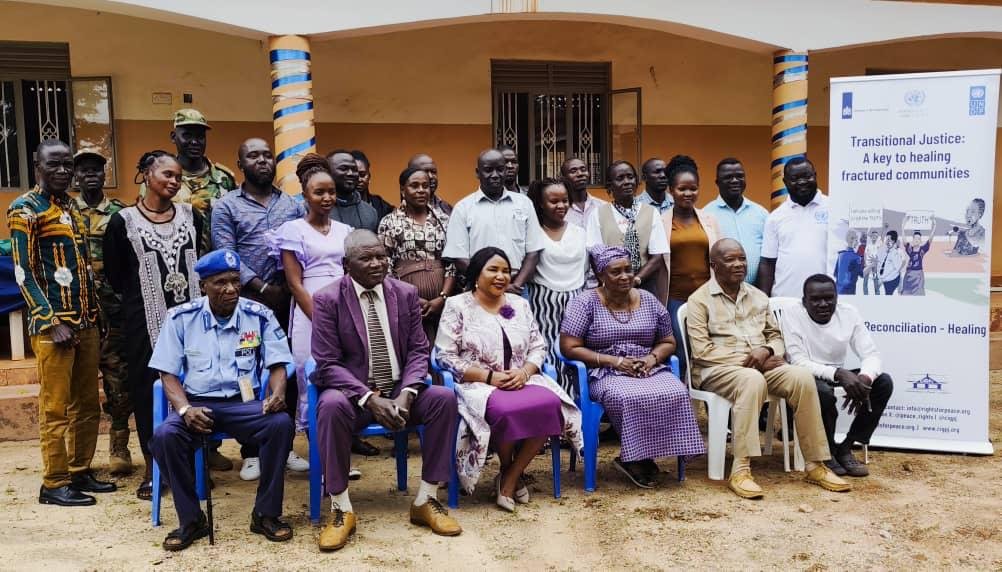
More than 20 community influencers drawn from security forces, parliament, media, religious institutions, and civil society in Western Equatoria State have completed a one-day Training of Trainers (ToT) workshop on Transitional Justice, a process considered crucial for healing South Sudan’s fractured communities.
The training, organized by the Centre for Inclusive Governance, Peace and Justice (CIGPJ) in partnership with Rights for Peace and in coordination with the Young Women Christian Association (YWCA), was supported by the Kingdom of the Netherlands through the UNDP and UN Peace building Fund.
Speaking on behalf of the organizers, Ms. Veronica Igale, Advocacy Coordinator with Rights for Peace, said the training was part of an outreach effort to raise awareness on two transitional justice laws passed last year under the framework of the 2018 Revitalized Peace Agreement.
“This workshop is not just about sharing knowledge but about empowering key players in Yambio to become messengers of justice, truth, and reconciliation within their communities, the transitional justice process in South Sudan is meant to be transparent, and feedback from the grassroots is critical,” Igale explained.
Transitional justice was enshrined in the 2018 Revitalized Agreement on the Resolution of Conflict in South Sudan (R-ARCSS), which outlined mechanisms such as the Commission for Truth, Reconciliation and Healing (CTRH), the Hybrid Court for South Sudan, and the Compensation and Reparation Authority (CRA).
These institutions were designed to address wartime atrocities, promote accountability, and restore trust among South Sudanese communities who have endured cycles of violence since 2013.
Officiating the opening session, Rt. Hon. Ann Tuna Richard, Speaker of the Transitional Western Equatoria State Legislative Assembly, said the training comes at a critical time when citizens are still struggling with the aftermath of conflict in Western Equatoria State and South Sudan at large.
“Our communities have endured untold suffering families torn apart, lives lost, property destroyed, and women and men traumatized. Justice cannot be delayed, the lawmakers and government officials must ensure that perpetrators are brought to book, and communities are given the chance to heal through truth and reconciliation.” She said
She also praised donors for bringing the initiative to Yambio, noting that insecurity in parts of the state, particularly in Tombura County where thousands remain displaced, has left citizens yearning for justice and reconciliation.
For participants, the training offered both a learning opportunity and a platform to reflect on the country’s troubled past.
Mr. Karim Justine Makasi, a participant from Men’s Alliance for Women and the Needy, said transitional justice is the missing link in consolidating peace in South Sudan.
“Our independence in 2011 was overshadowed by conflict in 2013 and 2016. Communities continue to suffer displacement, killings, and destruction of property, strengthening transitional justice institutions will not only deliver justice but also restore confidence in government systems and rebuild trust among our people.” Said Makasi
Western Equatoria State has been among the regions hardest hit by conflict and intercommunal violence, leaving behind scars of mistrust and broken social fabric.
Organizers of the training believe empowering community influencers to cascade knowledge and facilitate dialogue will accelerate healing and peace building.
According to Igale, follow-up activities will include radio programs, sensitization materials (including a pictorial guide and a citizens’ handbook) and community dialogues to ensure ordinary citizens engage in the transitional justice process.
“Peace is within us,” she emphasized. “It starts when communities acknowledge past wrongs, seek forgiveness, and demand accountability. Transitional justice gives us the tools to make this possible.”
The newly trained influencers are now expected to return to their constituencies and share knowledge with youth, women, traditional leaders, and faith-based groups, amplifying the message that justice and healing go hand in hand.
As South Sudan inches closer to its first elections in 2026, initiatives like this are seen as vital in mending broken trust and giving communities a voice in shaping a peaceful and just future.