
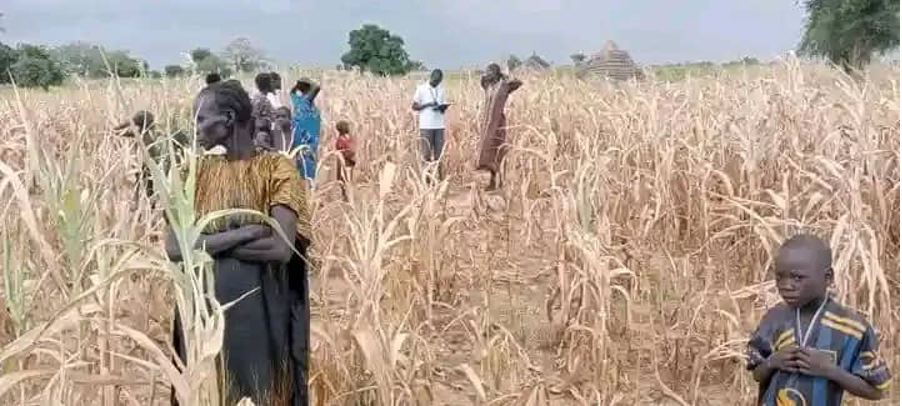
Authorities in parts of South Sudan are calling for urgent government and humanitarian intervention as prolonged dry conditions destroy crops, dry up water sources and threaten to deepen food insecurity among vulnerable communities.
The warning is emerging from Eastern Equatoria and Northern Bahr el Ghazal, where farmers and local authorities say poor rainfall is already affecting food production, livestock and household livelihoods.
In Eastern Equatoria, Governor Louis Lobong Lojore has appealed to the national government, humanitarian agencies and development partners to scale up assistance, warning that communities cannot afford to wait for the situation to deteriorate further.
Speaking during a visit to a sorghum farm in Kapoeta South County, Lobong described the condition of crops and water sources as alarming, particularly in areas of Greater Kapoeta that have traditionally supplied food to surrounding communities.
“The Singaita River has dried up, water sources from the Didinga Mountains are disappearing, and now here in Kapoeta South the sorghum in this entire farm has completely withered,” Lobong said.
He warned that the failure of the agricultural season could have serious consequences for women, children and elderly people who depend heavily on farming and livestock for survival.
“The people need urgent intervention,” Lobong said.
The governor urged partners to go beyond food assistance by supporting water supply, livestock and alternative livelihoods. He said the humanitarian needs were already visible on the ground, even as a scientific assessment of the drought continues.
The dry spell has also forced livestock keepers to move animals across borders and into neighbouring areas in search of pasture and water. Artisanal miners have equally been affected as water sources used for mining activities continue to disappear.
Similar concerns are being reported in Northern Bahr el Ghazal, where international non-governmental organisations, working with the state Relief and Rehabilitation Commission, have launched an assessment of crop losses caused by poor rainfall.
Acting Chairperson of the state RRC, Gabriel Bol Dut, said recent visits to Aweil East and Aweil South counties showed significant crop losses.
“It is more likely that our people are going to suffer, and as such, we have to do more in order to brainstorm what to do about the food insecurity,” Dut said.
He said assessment teams would visit selected communities to determine the extent of the damage and identify areas requiring immediate assistance.
“I recently visited areas which were reportedly mentioned to be suffering from the dry spell, especially in Malual-Baai Payam, and we witnessed it ourselves. The same applies to Aweil South County,” he said.
Local leaders in Aweil East are also urging authorities and partners to invest in water infrastructure to help communities cope with unreliable rainfall.
Executive Chief Yel Yel Kuol said farmers were already struggling to save their crops.
“There is little we can do because most of the areas I have mentioned are severely affected by the lack of rain, and crops are withering and drying up,” Kuol said.
Authorities say the dry spell is affecting communities across Northern Bahr el Ghazal, raising fears that crop failure could further increase pressure on households already facing food insecurity.
The situation has prompted calls for coordinated action involving the national government, state authorities, humanitarian organisations, development partners and international donors.
Officials are seeking emergency food assistance alongside clean water, livestock support, agricultural inputs, cash assistance and water-harvesting projects.
The warnings from the two states point to a growing humanitarian concern: if intervention is delayed until crops completely fail, communities could face a far deeper food and water crisis.