
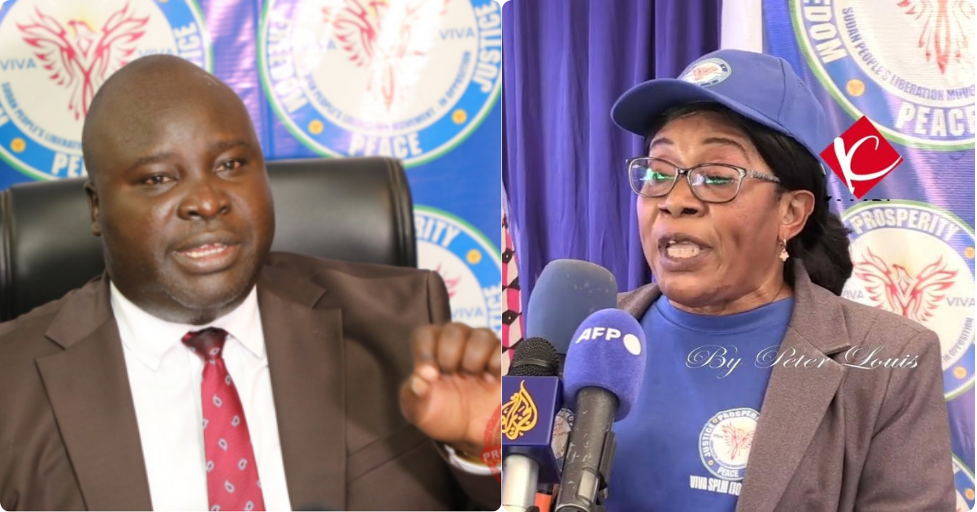
The leadership crisis inside South Sudan’s main armed opposition movement has entered a new and potentially decisive phase, with Acting Chairman Oyet Nathaniel and Secretary-General Regina Joseph Kapa each declaring the other’s actions unconstitutional and laying competing claims to authority over the SPLM/A-IO.
The latest confrontation has transformed what began as an internal disagreement over strategy, leadership and the future of the movement into an open institutional struggle, with rival factions disputing who has the constitutional power to suspend leaders, convene meetings and speak on behalf of the organization.
Nathaniel issued a press statement Saturday and mounted a forceful defense of his position, rejecting Kapa’s August 31st decision to suspend him and the commander-in-chief.
He said Kapa, whom he had already suspended from office, had no authority to take such action.
“I want to categorically dismiss this claim that the secretary-general of the SPLM, SPLA-O, has no competence or powers to dismiss or suspend any officer of the party, especially at the level of the chairman or the acting chairman or the deputy chairman of the party,” Nathaniel stated.
He added, “The office of the secretary-general has specific functions and roles which are clearly stipulated in the constitution of the SPLM, SPLA-IO. The decision of the secretary-general claiming to be acting on the resolution of the political bureau is null and void.”
Nathaniel further challenged the legitimacy of a political bureau meeting that he said was used to justify his suspension.
According to him, the meeting lacked the constitutional quorum and was held without the participation or presiding authority of the acting chairman.
His second major argument centers on the party’s constitutional provisions governing the removal of its top leadership.
“It should be noted that the suspension of the acting chairman or the chairman of the party and his deputy can only happen in the national convention. It cannot happen in any other forum other than the national convention.,” he said.
“That is as per article 17.2 which states that the chairperson or the deputy chairperson of the party may be removed by the national convention in an extraordinary session convened on the request of at least one third of members of the NSE for violations of this constitution or gross misconduct provided that the resolution for the removal of the chairman or deputy chairman shall be carried out by two thirds majority of all members of the national convention,” he stressed.
The competing claims have created an extraordinary situation in which both sides have effectively sought to invalidate the authority of the other.
Two suspensions, one movement
The immediate dispute escalated on August 31st, when Kapa suspended Nathaniel and the commander-in-chief, citing alleged gross misconduct and violations of the SPLM/A-IO’s basic documents.
Nevertheless, Nathaniel noted that the political bureau meeting that purportedly endorsed his suspension could not legally bind the movement.
He stated that at least 17 political bureau members were required for such a meeting, nine members outside Juba were involved in the meeting, while 17 others remained in the capital, with some detained.
The dispute over numbers and procedure has consequently become central to the larger leadership struggle.
Nathaniel argued that the political bureau meeting was “illegal” because the chairman was detained in Juba, while he, as acting chairman, was not present to preside over it.
“The national convention of the SPLM/A-IO did not take place in order to do this business,” Nathaniel emphasized, describing the claims surrounding the meeting as “baseless, unfounded and a fabrication.”
The crisis has also spilled beyond the question of procedure into a broader contest over the political and military direction of the movement.
Military command backs Kapa
The leadership contest took another turn when the SPLM/A-IO military command backed Kapa and moved to recognize her as acting chairperson of the party.
That decision further complicated an already divided leadership structure, effectively placing the political authority claimed by Oyet against a rival arrangement backed by elements of the military command.
The result is a movement increasingly operating through competing centers of authority, with each faction presenting its actions as necessary to preserve the party’s constitutional order.
But the military wing has sought to draw a line between the political dispute and the possibility of renewed armed confrontation within the movement.
In a statement issued on Friday, Col. Lam Paul Gabriel, SPLA-IO’s spokesperson, described the dispute as an administrative and constitutional matter.
“What is currently happening is administrative issues, understanding the constitution of the movement and how it’s supposed to function,” he posed.
He dispelled fears that the competing camps could turn their political differences into fighting between SPLA-IO forces.
“It is not really something that will trigger violence, as people might think, that maybe there will be clashes between the SPLA-IO forces. That is not going to happen because the SPLA-IO is bigger than an individual or a few individuals,” he emphasized.
Nathaniel maintained that his suspension of Kapa and others followed what he described as an attempt to undermine the party’s constitutional structure.
He underlined that Kapa and those he accused of influencing her were suspended after what he described as an unauthorized political bureau meeting.
“This was what warranted the suspension of the secretary-general and those who are implicated in the influencing of the secretary-general to carry out this illegal meeting to cause the stabilization of the party were also suspended,” he noted.
The rival decisions have raised a fundamental question for the SPLM/A-IO: who has the authority to lead the movement while its chairman remains in detention?
The crisis goes back to Machar’s arrest
The current confrontation did not emerge in isolation.
Nathaniel traces the roots of the internal crisis to the events of March 2025, when SPLM/A-IO Chairman and Commander-in-Chief Dr. Riek Machar was arrested and detained following the Nasir County incident.
The arrest fractured the movement’s political and military structures and left senior members divided between those who remained in Juba, those who fled to exile and those operating from opposition-controlled areas.
Nathaniel said the detention of Machar created a leadership vacuum and triggered disagreements over how the movement should respond to the government.
“Following the March 2025 accident in Nasir County and the arrest and detention of Dr. Riak Machaten Ndugon, the chairman and commanding chief of the SPLN-SPLAIU, there has been misunderstanding among the members,” he said.
He underscored that the disagreement was not initially simply about personalities, saying that it centered on a fundamental strategic question: whether the SPLM/A-IO should continue pursuing dialogue under the revitalized peace agreement or prepare for armed resistance if the government refused to release Machar and other detainees.
Two competing approaches emerged
One faction favored non-violent political engagement and negotiations and the other supported resistance as a fallback position if dialogue failed.
Nathaniel said consultations involving political and military leaders eventually endorsed both strategies, with dialogue preferred but resistance retained as a “default strategy.”
That strategic divide later became intertwined with the question of who had the authority to reorganize the movement’s political and military structures.
From political disagreement to organizational rupture
Nathaniel stressed that he was subsequently mandated to reorganize the political structure, including appointing and relieving officials, while opposition-controlled areas were to receive a civil-military administrative structure.
The plan also involved restructuring military, security and police structures and mobilizing personnel and resources.
But the resistance strategy itself became controversial within the movement.
Some members, Nathaniel said, opposed the approach because they feared it would lead to further bloodshed, displacement and destruction.
He also accused opponents of sabotaging logistical mobilization, appointments and attempts to exercise the authority he said had been transferred to the acting chairman and commander-in-chief.
The result was a growing struggle between those favoring continued dialogue and those advocating resistance.
That strategic disagreement increasingly became a leadership dispute.
Phar Kuol and the earlier fractures
The history of the current split also reaches back to the immediate aftermath of Machar’s arrest in March 2025.
On April 7, 2025, Nathaniel announced the suspension of Stephen Par Kuol, then Minister of Peacebuilding, alongside Agok Majur Kur, Diing Lam and Luke Thoan Teny.
Nathaniel accused the four of engaging in activities that created internal divisions and sought to replace SPLM/A-IO chairman Riek Machar.
The move marked one of the first major institutional confrontations inside the opposition movement after Machar’s detention.
Kuol rejected Nathaniel’s authority, and within days, the faction based in Juba moved in the opposite direction.
On April 9th, 2025, a consultative meeting of the SPLM-IO faction in Juba appointed Kuol as interim chairman, with Lasuba Wango as deputy interim chairman and Agok Makur as secretary-general.
The move was boycotted by several senior SPLM-IO figures, including Secretary-General Regina Kapa.
That sequence effectively turned an internal disagreement into a wider leadership confrontation as Kuol challenged Nathaniel’s authority.
The dispute became an important precursor to the leadership crisis now pitting Nathaniel against Kapa and elements of the SPLM/A-IO military command.
It also demonstrated how quickly the detention of Machar transformed disagreements over the implementation of the peace agreement into a contest over who could legitimately exercise authority within the movement.
These successive confrontations have contributed to a political environment in which competing interpretations of authority, loyalty and constitutional procedure have become increasingly difficult to reconcile.
The detention of Machar, the departure of senior officials from Juba, the rise of rival military and political centers and the disagreement over whether to pursue dialogue or resistance have all fed into the latest rupture.
A movement at a crossroads
Oyet’s latest address goes beyond a defense of his own position, it is an attempt to explain how the SPLM/A-IO arrived at its present crisis and why he believes his leadership remains legitimate.
He portrays the current confrontation as part of a broader struggle to preserve what he called the constitutional order of the movement.
However, his opponents have taken a different position, with Kapa suspending him and the military command subsequently backing her as acting chairperson.