


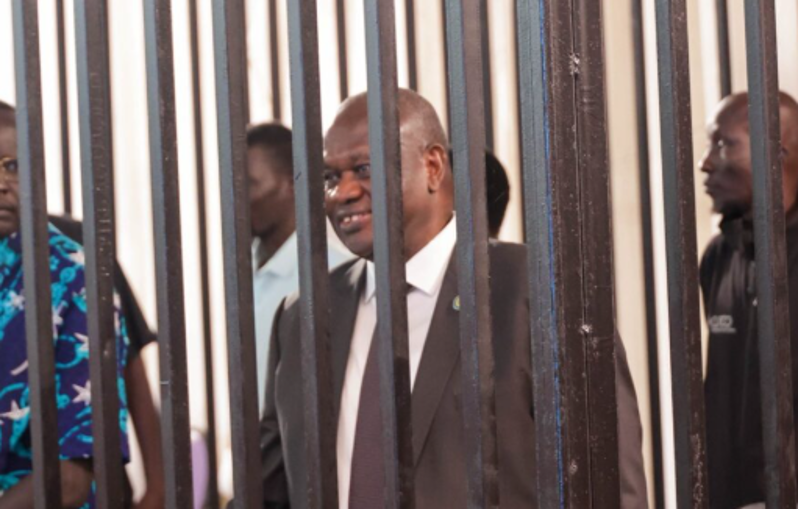
The defense team representing First Vice President and SPLM/A-IO leader Dr. Riek Machar and seven co-accused on Wednesday challenged the prosecution’s attempt to restrict how the accused present their defense.
They argued that the proposed procedure would undermine constitutional guarantees and procedural fairness.
The arguments were presented during the 112th session of the Special Court on the Incident of Nasir, held at Freedom Hall in Juba.
The defense was responding to a prosecution submission filed on August 21 concerning the accused persons’ right to legal representation and the procedure to be followed under Section 197(1) of the Code of Criminal Procedure Act, 2008.
The prosecution has sought to have the accused examined on the evidence and charges against them before they are allowed to present their defense statements.
The defense rejected that position, arguing that Section 197(1) gives the court discretion over the order in which an accused may be questioned and does not expressly prevent an accused from first reading a prepared statement.
The defense also sought clarification over comments made in open court concerning the possibility of accused persons changing their advocates.
Counsel argued that seeking clarification on the issue should not be interpreted as an attempt to interfere with judicial independence. Instead, they maintained that the right to legal representation is protected under Article 19 of the Transitional Constitution.
According to the defense, remarks suggesting that an accused “may consider changing” advocates could create pressure within the attorney-client relationship, even where the court has not formally ordered a change of counsel.
The defense therefore asked the court to make clear that the accused remain free to retain their chosen lawyers without facing any adverse inference.
Defense rejects allegations of delay
The lawyers also strongly rejected allegations that their conduct amounted to “public theatrics,” collective pressure or deliberate attempts to delay the trial.
They argued that exercising constitutional rights cannot, by itself, constitute an abuse of court process or an intentional effort to frustrate proceedings.
Regarding Machar, identified in the proceedings as the fifth accused, the defense said an accused person represented by counsel does not lose the right to raise personal concerns relating to safety, treatment or legal representation.
While acknowledging the seriousness of the allegations surrounding the Nasir incident, the defense maintained that the gravity of the charges cannot diminish constitutional protections afforded to an accused person.
A major point of contention was the procedure proposed under Section 197(1).
The defense noted that the first four accused had previously been allowed to present their statements before responding to questions from the court.
Applying a different and more restrictive procedure to Machar, the defense argued, would raise concerns about equal treatment and procedural fairness.
Counsel further argued that reliance on provisions governing non-summary trials, including Section 224(2)(e), could not be used to override the protections and discretion contained in Section 197(1).
Defense asks court to reject prosecution application
At the conclusion of its submission, the defense asked the court to dismiss the prosecution’s objections to its earlier application and reject the prosecution’s counter-application under Section 197(1).
It also asked the court to grant the defence’s original application and formally affirm the accused persons’ right to retain counsel of their choice.
The court adjourned the proceedings until Friday, August 28, 2026, when the prosecution is expected to respond to the defense submission.


