
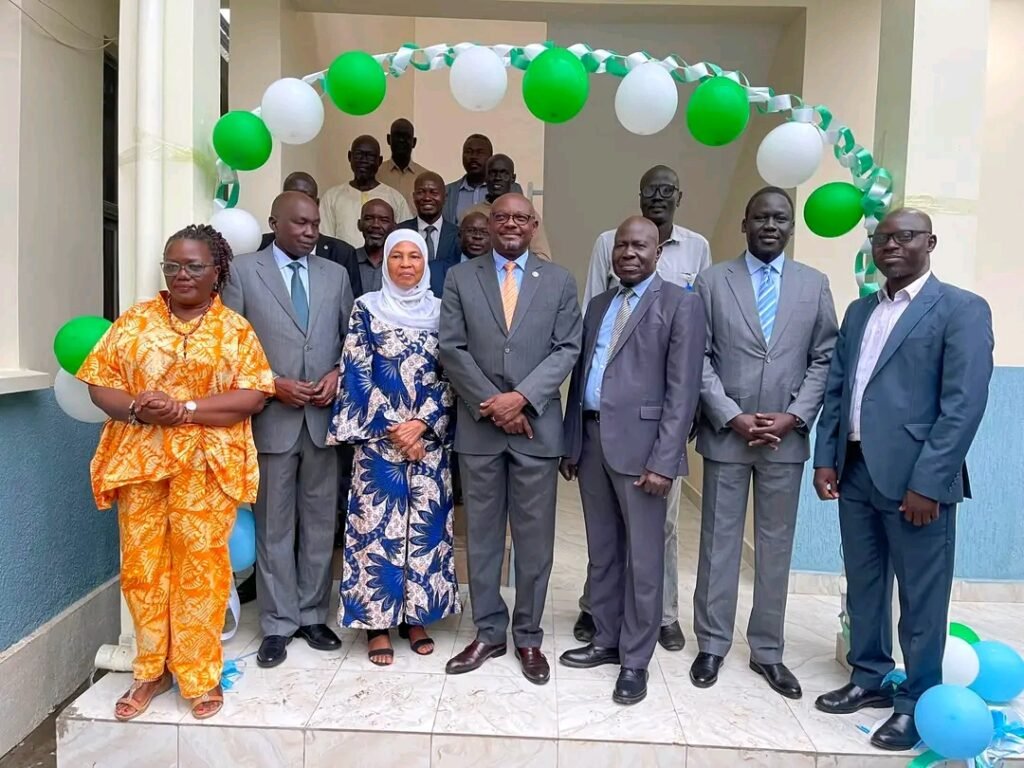
South Sudan’s agricultural development agenda has received a fresh institutional boost following the inauguration of a modern office complex for the Single Project Coordination Unit (SPCU) at the Ministry of Agriculture and Food Security headquarters in Juba.
The facility, funded by the African Development Bank (AfDB), is expected to strengthen the ministry’s capacity to coordinate, manage and implement agricultural development projects at a time when South Sudan is seeking to increase food production, improve farmers’ livelihoods and reduce persistent food insecurity.
National Minister of Agriculture and Food Security Clement Juma officially inaugurated the facility on Thursday during a ceremony attended by ministry officials, project staff and representatives of the African Development Bank.
The new building includes modern office spaces and meeting facilities designed to provide a more conducive working environment for the SPCU and ministry personnel responsible for coordinating development projects.
Speaking during the inauguration, Minister Juma said the new infrastructure should translate into improved performance and stronger delivery of agricultural programmes.
He urged ministry staff and SPCU officials to take responsibility for maintaining the facility and using it effectively to achieve the objectives of the ministry.
The minister also linked proper management of the building to the government’s ability to attract additional development support.
“We have high expectations from our staff and the SPCU team. This facility must be properly managed and maintained so that it can serve its purpose and demonstrate to our development partners that their investments are being put to good use,” Juma said.
The minister’s remarks underline the government’s expectation that donor-funded infrastructure should produce tangible institutional results rather than simply add to the country’s public buildings.
The African Development Bank reaffirmed its commitment to supporting South Sudan’s agricultural development, with its Acting Country Representative emphasizing the importance of agricultural value-chain development under the bank’s country strategy.
The bank’s support comes as South Sudan continues to face significant challenges in food production, rural development and access to agricultural markets.
Strengthening institutions responsible for implementing agricultural programmes is considered important to ensuring that financial and technical resources reach farmers and communities effectively.
A stronger project coordination mechanism could help improve planning, monitoring and implementation of agricultural investments while reducing delays in delivering programmes.
The Director of the Single Project Coordination Unit expressed optimism that the new working environment would improve the performance of project personnel.
The previous working conditions could create challenges for coordination, meetings and the day-to-day management of development programmes.
With dedicated offices and modern meeting facilities, the SPCU is expected to have improved capacity to coordinate stakeholders and manage projects more efficiently.
The facility could also provide space for government officials, development partners and technical teams to meet and review the implementation of agricultural programmes.
The investment comes against the backdrop of South Sudan’s continuing struggle with food insecurity, despite the country’s significant agricultural potential.
Agriculture remains a major source of livelihoods for rural communities, yet production continues to be affected by limited mechanization, inadequate infrastructure, weak market access, insecurity, limited financing and insufficient agricultural inputs.
Improving the capacity of the Ministry of Agriculture to coordinate development projects could therefore have implications beyond the ministry itself.
Effective agricultural programmes could support farmers with production inputs, strengthen value chains, improve access to markets and contribute to increased domestic food production.
The inauguration marks an institutional milestone, but the real test will be whether the new facility contributes to measurable improvements in agricultural project delivery.
Development partners increasingly require strong coordination, accountability and monitoring to ensure that investments achieve their intended results.
For the SPCU, the new facility provides improved physical conditions for carrying out that responsibility.
The unit will need to demonstrate that better working conditions translate into faster project implementation, stronger coordination and improved outcomes for beneficiaries.
Minister Juma’s call for proper maintenance also carries a broader message to development partners.
South Sudan continues to depend significantly on international development assistance to support sectors such as agriculture, health, education and infrastructure.
Demonstrating that donor-funded facilities are properly managed could strengthen confidence among existing partners and potentially encourage additional investments.
The AfDB’s continued engagement with the Ministry of Agriculture signals an interest in supporting South Sudan’s efforts to develop agricultural value chains and strengthen the sector’s contribution to the economy.
The new SPCU building is ultimately intended to serve as more than an office complex.
It is expected to become part of the institutional infrastructure supporting South Sudan’s agricultural transformation agenda.
If effectively utilized, the facility could improve coordination between the government, development partners and agricultural programmes, helping ensure that investments are translated into practical benefits for farmers.
For South Sudan, where increasing domestic food production is essential to addressing food insecurity and creating rural employment, stronger agricultural institutions will remain critical.
The inauguration therefore marks the beginning—not the end—of the challenge.The African Development Bank has provided the infrastructure; the responsibility now lies with the Ministry of Agriculture and its project teams to turn improved working conditions into better agricultural programmes, stronger value chains and tangible results for South Sudanese farmers.