
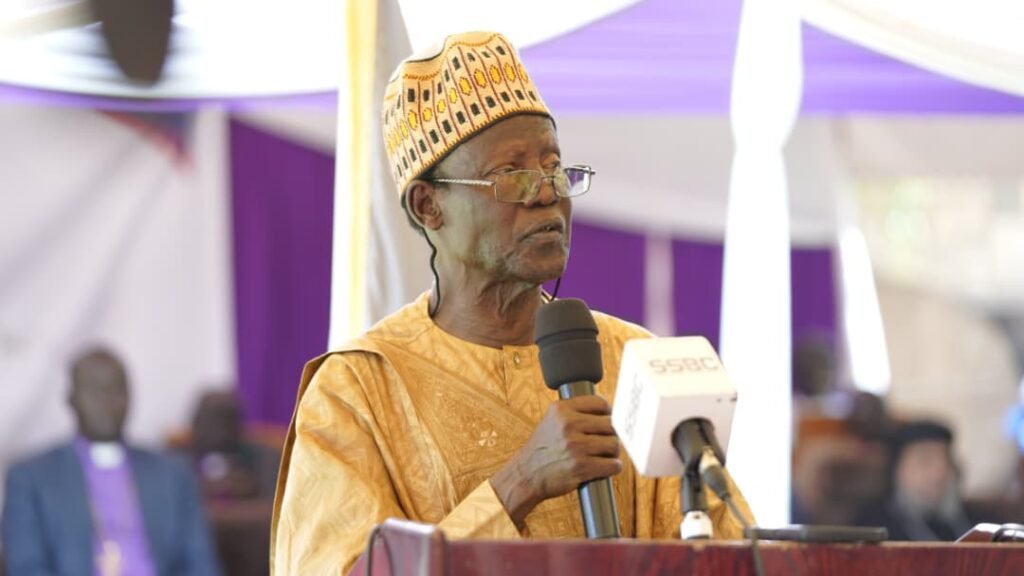
Vice President James Wani Igga has called on South Sudanese, including political leaders and members of the public, to embrace forgiveness, unity and transformation, warning that prayers for peace must be accompanied by changes in how people treat one another.
Wani Igga made the remarks on Monday during a national day of prayer and fasting organized by the South Sudan Council of Churches in Juba, where hundreds of worshippers gathered at All Saints Cathedral to pray for the country.
The Vice President said the purpose of prayer and fasting should extend beyond the religious gathering, arguing that participants should leave transformed rather than return to the same attitudes and behaviors they had before the prayer.
He challenged worshippers to examine whether their prayers were producing meaningful changes in their relationships with one another, particularly in a country that has experienced years of political divisions and conflict.
“True fasting must produce a change of heart,” Wani Igga said.
He questioned the contradiction between praying for peace while continuing to promote division and hostility.
“If we pray for peace, but promote divisions, what have our prayers done and changed?” he asked.
The Vice President also linked national healing to personal forgiveness, saying South Sudanese cannot genuinely seek healing for the country while refusing to forgive their neighbours.
“If we ask God to heal our nation, but refuse to forgive our neighbors, where does national healing begin from?” he asked.
Wani Igga emphasized that prayer should lead to transformation in the lives of individuals and communities.
He urged those attending the national prayer to reflect on whether they were prepared to change their attitudes toward others, particularly toward people with whom they may have disagreements or longstanding grievances.
His message placed personal responsibility at the center of the country’s search for peace, suggesting that national transformation begins with changes in individual behavior.
The Vice President cautioned against treating prayer as an isolated religious exercise without corresponding action.
He said returning from prayer with the same hatred, divisions and attitudes would undermine the purpose of the gathering and amount to deceiving both oneself and God.
The call comes at a time when South Sudan continues to navigate political tensions, reconciliation challenges and preparations for national elections.
By addressing both politicians and ordinary citizens, Wani Igga broadened the responsibility for peace beyond government and political institutions, stressing that unity requires participation from society as a whole.
His message also framed forgiveness as an important component of national healing, rather than simply a private religious matter.
For the hundreds gathered at All Saints Cathedral, the national day of prayer and fasting therefore carried a message extending beyond worship: that peace requires changes in attitudes, relationships and conduct.
Wani Igga’s appeal was ultimately for South Sudanese to ensure that the lessons of prayer are reflected in their daily lives.
“If we pray for peace, but promote divisions,” he asked, “what have our prayers done and changed?”
The question placed the responsibility for translating prayer into peace squarely on the people themselves—through forgiveness, unity and a willingness to change.