
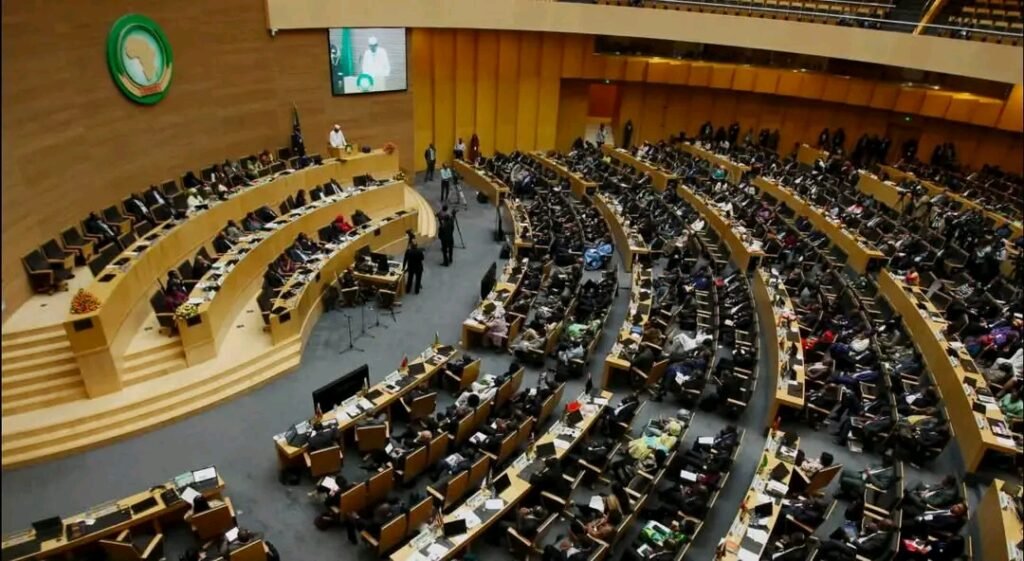
The African Union Peace and Security Council (PSC) has issued a strong warning to South Sudan’s political leadership, calling for the immediate resumption of dialogue, completion of the country’s long-delayed security arrangements and an end to military confrontation as the country moves toward the December 22, 2026 general elections.
In a communiqué adopted at its 1,364th meeting on August 26, 2026, the PSC said persistent political disagreements among signatories to the Revitalized Peace Agreement, renewed armed confrontations and delays in implementing key transitional benchmarks were threatening South Sudan’s fragile political transition.
The continental body called on the Revitalized Transitional Government of National Unity (RTGoNU) and all signatories to the peace agreement to resume direct, good-faith political dialogue without preconditions, with support from the AU High Representative for the Horn of Africa and the Red Sea, the AU High-Level Ad Hoc Committee for South Sudan (C5) and the Intergovernmental Authority on Development (IGAD).
The AU’s intervention comes as South Sudan prepares for elections scheduled for December 22, with the transitional period expected to conclude in February 2027.
The Council reiterated that the transitional mandate must “conclusively end in February 2027 without further extensions,” placing renewed pressure on the country’s political leadership to resolve outstanding peace and security issues while maintaining the election timetable.
The PSC made clear that political disagreements cannot be resolved through armed confrontation, warning all parties against military mobilization and inflammatory rhetoric.
It stressed that there is no military solution to South Sudan’s political impasse and demanded an immediate and unconditional cessation of hostilities.
The Council also called on political leaders to release political detainees in accordance with national law and return to inclusive, consensus-driven dialogue as the principal means of achieving national reconciliation.
The message represents one of the strongest elements of the AU’s latest assessment: the country’s political transition cannot be sustained if disagreements among political actors continue to spill into armed confrontation.
The Council expressed particular concern over the deteriorating political and security environment, including armed confrontations reported in Jonglei, Upper Nile and other parts of the country.
At the centre of the AU’s security concerns is the incomplete implementation of the security arrangements contained in the Revitalized Agreement.
The PSC called on all parties to urgently complete the unification, training and deployment of the Necessary Unified Forces (NUF), describing the process as a critical prerequisite for maintaining the permanent ceasefire.
It further urged the government and peace signatories to accelerate broader Security Sector Reform (SSR) and Disarmament, Demobilization and Reintegration (DDR) programmes.
The call comes years after the peace agreement established security-sector arrangements intended to bring forces from different parties together under a unified national security structure.
The AU’s latest position places completion of those arrangements firmly within the broader requirements for sustainable peace and a stable political transition.
While the PSC welcomed the South Sudanese government’s commitment to hold general elections on December 22, it stressed that elections alone cannot guarantee stability.
The Council said credible elections require political consensus, inclusivity, an open civic space, citizen security and effective mechanisms for resolving electoral disputes.
The AU therefore appears to be linking the country’s electoral ambitions with progress in implementing the peace agreement and reducing political and military tensions.
The Council’s insistence that the transitional mandate should end in February 2027 also increases the political stakes surrounding the December vote.
For South Sudan, the challenge is now twofold: prepare for elections while simultaneously addressing the political and security conditions necessary for those elections to contribute to a peaceful transition rather than deepen existing divisions.
The AU’s call for dialogue comes after the failure to convene the planned August 12, 2026 inter-party dialogue, which the PSC identified as part of the broader deterioration in the political environment.
The Council urged the RTGoNU leadership and all signatories to the peace agreement to return to negotiations immediately and without preconditions.
It called for the process to be supported by regional and continental institutions, including AU and IGAD structures, in an effort to bridge differences over the implementation of outstanding provisions of the peace agreement.
The emphasis on direct dialogue reflects the AU’s broader position that political disputes must be addressed through negotiation rather than force.
The Council’s concerns extend beyond political disagreements.
The PSC also strongly condemned the August 24 ambush in Jonglei State that killed two Ethiopian UN peacekeepers and injured seven others.
It called on the South Sudanese government to investigate the attack and hold those responsible accountable.
The incident has added to concerns over the security environment in parts of the country at a time when preparations for the December elections are accelerating.
For the AU, protecting civilians, peacekeepers and humanitarian personnel is essential to creating an environment in which political and electoral processes can proceed safely.
Beyond armed clashes, the Council also warned against rhetoric that could further inflame political tensions.
It called for an immediate halt to military mobilization, inflammatory statements and other actions that could undermine the ceasefire and destabilize the country.
The AU’s position places responsibility on political leaders and armed actors to exercise restraint and create space for political engagement.
It also underscores the importance of building confidence among the parties before the country enters the final months leading to the elections.
The AU’s latest communiqué leaves South Sudan facing a critical period in which political, security and electoral processes will have to move forward simultaneously.
The country has made progress toward the December polls, including the registration of political parties and preparations by electoral institutions. But the PSC’s warning makes clear that outstanding peace implementation, political disagreements and insecurity remain significant concerns.
The Council has also decided to hold a dedicated session on South Sudan’s electoral preparedness in October 2026, with the AU Commission expected to submit a detailed assessment of the country’s readiness.
That review is likely to provide another opportunity for the continental body to assess whether political and security conditions are improving sufficiently ahead of the December vote.
For now, the AU’s message is unequivocal: South Sudan’s political transition must remain anchored in dialogue, not confrontation; unified national security institutions, not fragmented forces; and a peaceful political process, not military solutions.
As the December elections approach, the ability of the country’s leaders to heed that message could prove decisive in determining whether the next phase of South Sudan’s political transition becomes a pathway toward stability or another source of political and security uncertainty.