
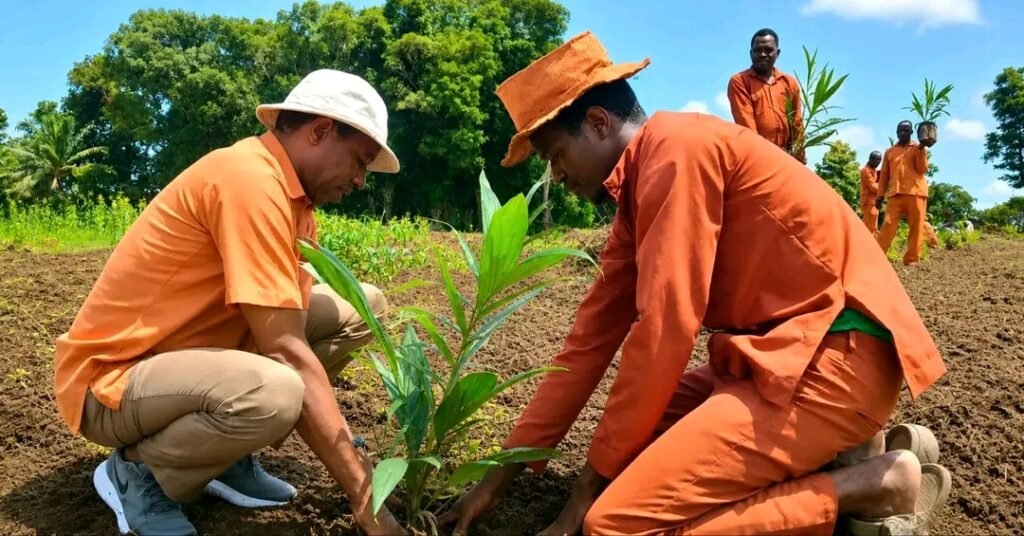
South Sudan’s drive to reduce food insecurity and unlock its agricultural potential is gaining momentum in Western Equatoria State, where Chinese-donated agricultural machinery is helping farmers move from labour-intensive cultivation toward mechanized production.
The equipment, donated by the Government of the People’s Republic of China through the Chinese Embassy in South Sudan and delivered to the Azande Kingdom in January 2026, has already been used for land ploughing and maize shelling, according to the Chinese Ambassador to South Sudan.
The initiative is being closely watched as a potential model for expanding mechanized agriculture in a country endowed with large areas of arable land but still heavily dependent on traditional farming methods.
The Chinese Ambassador said the project responds to one of South Sudan’s most pressing challenges—food insecurity—while supporting the country’s broader ambition to promote agriculture and strengthen rural livelihoods.
“One of the challenges South Sudanese people are facing is food insecurity. Azande Kingdom is a traditionally agriculture producing area. Donating agricultural machinery to the Azande Kingdom is just one of the many people’s livelihood projects China has done in South Sudan,” the ambassador said.
Mechanization opens new possibilities for farmers
For many farmers in Western Equatoria, preparing farmland has traditionally depended on manual labour. Clearing and cultivating large plots with hand tools can take considerable time and limit the amount of land families are able to farm during the agricultural season.
The introduction of tractors and other machinery is changing that equation.
Mechanized land preparation allows farmers to cultivate larger areas within shorter periods, potentially increasing production while reducing some of the physical burden associated with traditional agriculture.
The machinery has also been used for maize shelling, reducing the labour required after harvesting and demonstrating how mechanization can extend beyond land preparation.
The Chinese Embassy said considerable effort was invested in delivering the equipment to the Azande Kingdom.
“I am delighted to learn that these agricultural machines have been working well, contributing to land ploughing and maize shelling of local communities,” the ambassador said.
Western Equatoria’s agricultural potential
Western Equatoria has long been regarded as one of South Sudan’s important agricultural regions, with communities possessing extensive farming experience and access to productive land.
However, the state’s agricultural potential has not been fully realized because of challenges ranging from limited mechanization and poor rural roads to inadequate storage, market access and agricultural inputs.
The arrival of the machinery has therefore created renewed expectations that farmers can increase the scale of cultivation and move gradually from subsistence farming toward commercial production.
For the Azande Kingdom, the ultimate measure of success will be whether the equipment helps farmers produce enough food for their families while generating surplus for local markets.
China links project to wider African agricultural support
The Chinese government says its agricultural cooperation with South Sudan forms part of a wider effort to strengthen food production across Africa.
The ambassador said more than 200 Chinese agricultural experts have been deployed in Africa, while approximately 50,000 local professionals have received training under China’s agricultural cooperation initiatives.
He said China’s agricultural interventions are intended to promote modern farming technologies and strengthen local capacity.
“China’s efforts to boost Africa’s agricultural development do not stop at this project,” the ambassador said.
The statement places the Azande Kingdom project within a broader Chinese approach that combines technology, technical expertise and skills development.
Machines alone will not solve food insecurity
Despite the promise of mechanization, agricultural stakeholders acknowledge that tractors alone cannot transform South Sudan’s food system.
Farmers require access to affordable fuel, spare parts, qualified operators and mechanics to keep machinery functioning.
They also need improved seeds, agricultural extension services, storage facilities, roads and reliable markets where they can sell their produce.
Without these supporting systems, machinery risks becoming underutilized or difficult to maintain once initial project support ends.
This makes local capacity building a critical component of the agricultural transformation.
Youth skills could become another dividend
The machinery programme also provides an opportunity to equip young South Sudanese with technical skills.
Training local tractor operators and mechanics could create employment while ensuring that agricultural equipment can be maintained locally.
Sultan Abuariga, a machinery operator involved in the project, is among those gaining practical experience from the new technology.
Expanding such training could help create a new generation of agricultural technicians capable of supporting mechanized farming in Western Equatoria and other parts of South Sudan.
Farmers need stronger agricultural value chains
Farmers’ ability to increase production must be matched by improvements in the rest of the agricultural value chain.
Producing more maize, cassava, groundnuts, rice or vegetables will have limited economic benefits if farmers cannot store their harvest, transport it to markets or obtain fair prices.
The development of warehouses, processing facilities, rural roads and market networks could therefore determine whether mechanization leads to genuine improvements in household incomes.
A stronger agricultural value chain could also stimulate private investment in milling, food processing, transportation and agricultural input supply.
Security remains fundamental
Security is another factor that could determine the future of farming in South Sudan.
Farmers are less likely to expand cultivation or invest in machinery when insecurity threatens their land, livestock, families or harvested crops.
Stable communities would allow farmers to remain on their land, transport agricultural products and develop longer-term commercial farming plans.
For Western Equatoria, maintaining peace and strengthening local institutions will therefore remain important components of agricultural development.
Climate challenges add pressure
South Sudan’s farmers also face environmental pressures, including unpredictable rainfall, flooding and periods of drought.