
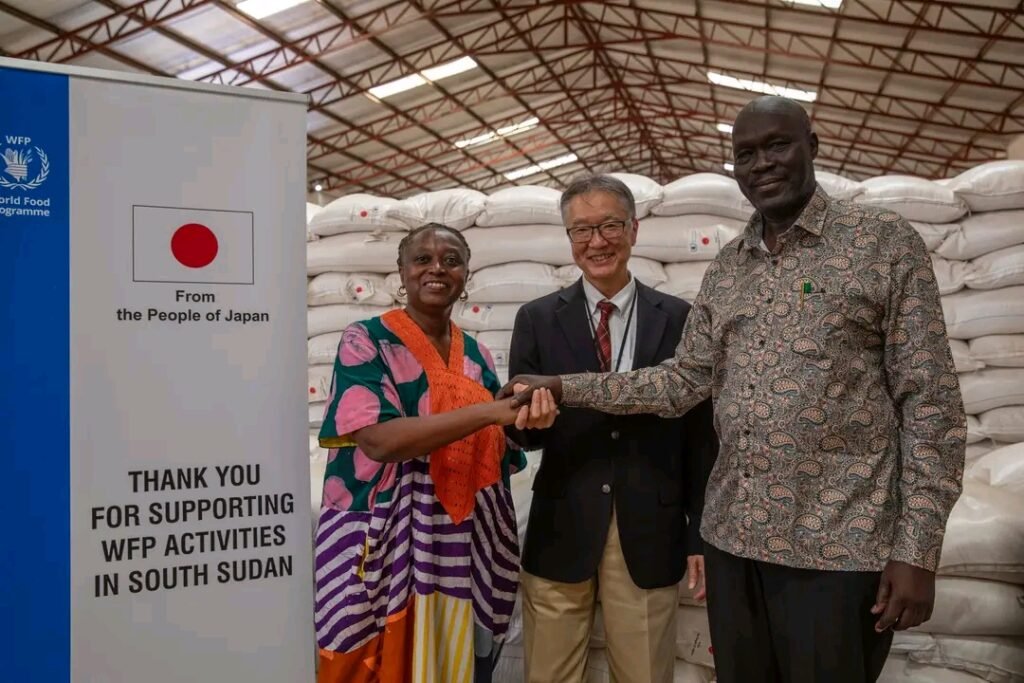
Japan has contributed JPY 350 million (approximately US$2.2 million) to the United Nations World Food Programme (WFP) to support lifesaving nutrition assistance for vulnerable women and children facing acute hunger and malnutrition in South Sudan.
The contribution comes as the country continues to grapple with one of the world’s most severe food and nutrition crises, with millions of people struggling to access adequate food amid humanitarian needs, limited resources and funding shortages.
According to WFP, more than 7.8 million people are facing acute food insecurity across South Sudan, while an estimated 2.2 million children under the age of five and 1.2 million pregnant and breastfeeding women are acutely malnourished.
WFP said the Japanese funding will enable it to provide critical nutrition support to more than 38,000 vulnerable women and children in some of the communities worst affected by the crisis.
The assistance will include treatment for 14,000 pregnant and breastfeeding women and girls suffering from acute malnutrition, alongside preventive nutrition interventions targeting more than 24,000 mothers and young children.
As part of the response, WFP will procure and distribute approximately 472 metric tons of Super Cereal Plus, a specialized nutritious food designed to prevent and treat malnutrition among vulnerable women and children.
The supplies will be directed to areas where malnutrition has reached critical levels, including Greater Jonglei, Upper Nile, Unity, Warrap and selected counties in Greater Bahr el Ghazal.
Japan’s diplomatic mission in South Sudan said the contribution reflects Tokyo’s longstanding commitment to supporting vulnerable populations and responding to urgent humanitarian needs in the country.
“The Government of Japan highly values the partnership with WFP in addressing urgent humanitarian needs in South Sudan,” said Hiromoto Oyama, Chargé d’Affaires ad interim of Japan to South Sudan.
He said the intervention comes at a critical moment as millions of people continue to face severe hunger and malnutrition.
The funding is also expected to help WFP sustain nutrition services at a time when humanitarian agencies are facing significant financial constraints.
WFP South Sudan Country Director Mutinta Chimuka described the Japanese contribution as critical support amid growing humanitarian needs and limited resources.
“At a time when millions in South Sudan face severe hunger and our resources are stretched to the absolute limit, Japan’s critical support is a lifeline of hope,” Chimuka said.
WFP has warned that humanitarian funding shortfalls are forcing reductions in assistance in several parts of South Sudan. The agency says continued support is essential to prevent further deterioration among people already facing food insecurity and malnutrition.
Without sustained humanitarian funding, vulnerable women and children face a heightened risk of progressing from moderate to severe malnutrition, potentially resulting in serious health complications and increased mortality.
Nutrition experts consider pregnant and breastfeeding women and young children among the groups most vulnerable to the effects of food insecurity. Inadequate nutrition during pregnancy and early childhood can have long-term consequences for physical growth, cognitive development and overall health.
The WFP-supported interventions will therefore combine treatment of acute malnutrition with preventive nutrition assistance, targeting both those already suffering from malnutrition and those at high risk of developing it.
The delivery of Super Cereal Plus is expected to form a key component of the intervention, providing nutrient-rich food to vulnerable beneficiaries in communities where access to adequate diets remains severely constrained.
The Japanese contribution comes against a backdrop of persistent humanitarian pressures in South Sudan, where food insecurity is driven by a combination of conflict and insecurity, displacement, economic hardship, climate-related shocks and limited access to basic services.
For communities in Greater Jonglei, Upper Nile, Unity, Warrap and parts of Greater Bahr el Ghazal, the additional nutrition support could provide an important lifeline to households struggling to meet their basic food needs.
However, WFP stressed that one contribution, while significant, cannot close the wider humanitarian funding gap.
The agency’s appeal for sustained international support remains critical as humanitarian organizations seek to maintain food and nutrition services for millions of South Sudanese facing hunger.
The Japanese funding is therefore expected not only to deliver immediate nutritional assistance to more than 38,000 women and children, but also to help prevent further deterioration in a crisis that continues to place some of South Sudan’s most vulnerable populations at risk.