
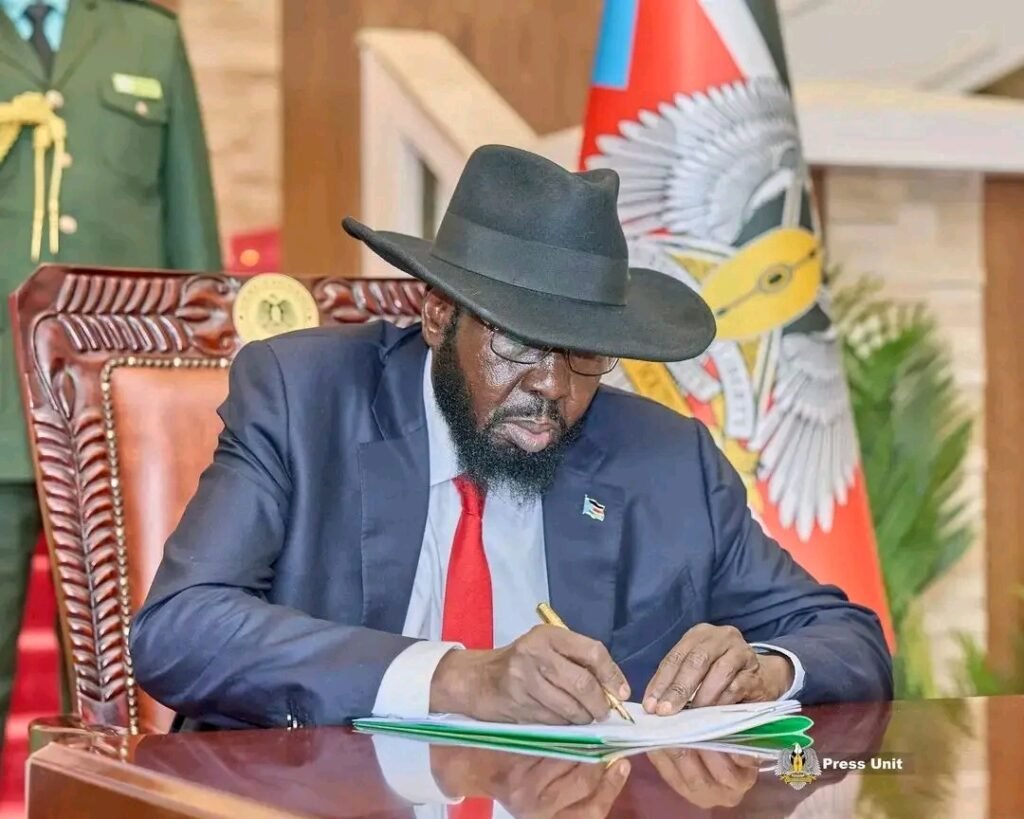
President Salva Kiir Mayardit has assented to a constitutional amendment removing key legal barriers to South Sudan’s planned December 22, 2026 general elections, formally opening the way for the country to move from legal preparations into the practical phase of organizing the polls.
The President signed the Transitional Constitution of the Republic of South Sudan, 2011 (as amended) (No. 13) Act, 2026 during a constitutional ceremony in Juba, following its passage by the Transitional National Legislative Assembly.
The amendment is significant because it delinks the conduct of national elections from the completion of the permanent constitution-making process and the National Population and Housing Census.
By separating the elections from those two processes, the constitutional change removes legal conditions that could otherwise have delayed or complicated the December polls, allowing electoral preparations to proceed on the basis of the amended transitional constitutional framework.
The presidential assent therefore represents a major political and constitutional milestone for South Sudan as the country prepares for its December 22 vote.
The amendment changes the legal relationship between the country’s electoral timetable and two major national processes—the permanent constitution-making process and the population census.
Under the new arrangement, the completion of the permanent constitution and the census will no longer have to precede the holding of the scheduled national elections.
The development gives electoral authorities and other institutions greater legal clarity as they move forward with preparations for the polls.
It also means that attention can increasingly shift from debating the legal basis for holding elections toward the practical requirements of conducting them.
These include voter registration, civic and voter education, electoral logistics, candidate and party preparations, polling arrangements and other technical aspects necessary for the December exercise.
The President’s assent is the latest step in a political and legislative process that began with a meeting of the Expanded Presidency and political party leaders on December 10, 2025.
The meeting reached consensus on the need to proceed with elections and activate relevant provisions of the Revitalized Agreement on the Resolution of the Conflict in South Sudan.
The process subsequently moved through government and peace-implementation institutions, including the Cabinet and the Reconstituted Joint Monitoring and Evaluation Commission (R-JMEC), before reaching the Transitional National Legislative Assembly.
A related amendment to the Revitalized Peace Agreement was assented to by President Kiir on July 22, 2026, creating the need to align the country’s domestic constitutional and electoral framework with the revised provisions.
The constitutional amendment was subsequently developed, considered by Cabinet and taken through the required legislative procedures.
The Transitional National Legislative Assembly approved the amendment on September 1, 2026, paving the way for President Kiir’s assent.
The latest development thus completes a critical part of the legal process underpinning the December elections.
With the constitutional amendment now signed into law, the focus shifts increasingly toward the practical organization of the December 22 elections.
The National Elections Commission and other electoral institutions now face the task of translating the legal framework into an operational electoral process capable of allowing eligible citizens to participate.
The change also gives political parties and prospective candidates a clearer electoral horizon as they prepare for the polls.
For voters, the constitutional development provides a legal basis for the planned exercise in which citizens will have the opportunity to choose their political representatives and national leadership through the ballot.
However, the removal of constitutional obstacles does not by itself resolve all challenges facing the electoral process.
The success of the December polls will also depend on the availability of adequate funding, logistical preparations, voter registration, civic education, security and the ability of political actors to maintain a peaceful environment.
The presidential assent places renewed responsibility on the country’s electoral and political institutions to ensure that the remaining preparations are carried out effectively.
The government has repeatedly maintained that the December elections should proceed, while political actors and stakeholders have continued to debate the conditions necessary for credible and peaceful polls.
The constitutional amendment now provides a clearer legal foundation for the scheduled election date.
It also marks an important transition in the country’s political process: from determining whether the legal framework allows elections to proceed to determining how those elections will actually be conducted.
The coming months are therefore expected to be critical for the National Elections Commission, political parties, civil society organizations and other stakeholders involved in the electoral process.
Although the amendment allows elections to proceed without waiting for completion of the permanent constitution, the constitutional reform process remains an important part of South Sudan’s longer-term political transition.
The decision to delink the two processes means the country can proceed with elections while continuing work toward a permanent constitutional settlement.
This creates a dual track for the country’s political transition—elections in December 2026 and continued constitutional development beyond the polls.
The President’s assent consequently represents more than a procedural signing ceremony. It removes a significant legal barrier, provides greater certainty around the electoral timetable and places South Sudan firmly into the practical preparations for the December 22 vote.
For millions of South Sudanese, the next stage will be whether the institutions responsible for the elections can turn that constitutional and political milestone into a credible, peaceful and effectively organized electoral process.