
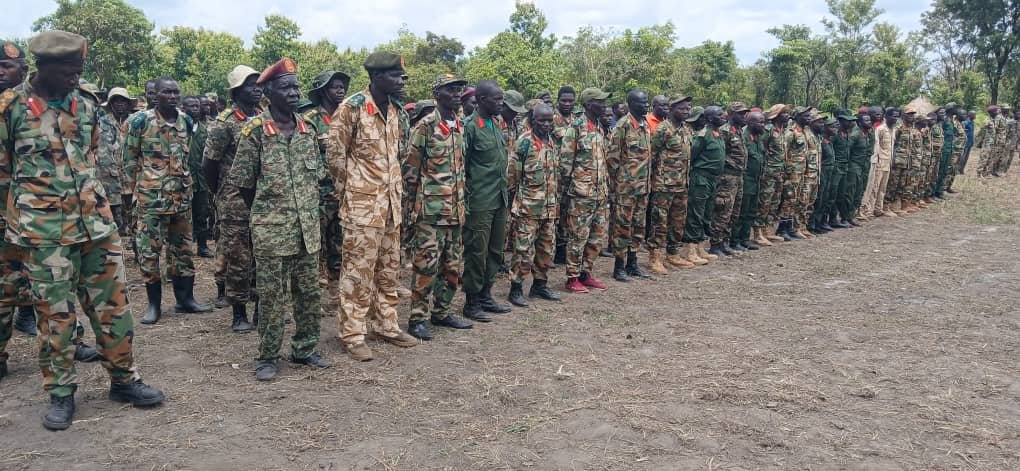
More than 3,000 former SPLM-IO fighters are preparing for registration, verification and integration into South Sudan’s national army in what authorities describe as a renewed push to implement the security provisions of the country’s revitalized peace agreement.
SSPDF Chief of Defence Forces General Santino Deng Wol visited the fighters at Lii-Rangu on Saturday as the government moves to advance the integration process.
The army chief was accompanied by Western Equatoria Governor Badagbu Daniel Rimbasa and senior SSPDF officers, including Assistant Director for Information and Public Relations Garang Ateny Alier.
The fighters reportedly left the SPLM-IO in 2025 and later reported to the SSPDF’s 6th Infantry Division headquarters in Western Equatoria.
General Wol said he was in the state on the directive of President Salva Kiir Mayardit to supervise the registration, verification and integration exercise.
He urged the former opposition fighters to remain disciplined and concentrate on their responsibilities as members of the national security forces.
Wol also said the government would provide uniforms and salaries following their integration into the SSPDF.
The process is directly linked to Chapter II of the 2018 Revitalized Peace Agreement, which provides for permanent ceasefire and transitional security arrangements, including the creation of unified national security forces.
The unification of rival forces has, however, remained one of the most difficult and delayed components of the agreement.
Previous efforts have faced challenges involving funding, cantonment, training and deployment. Reports in 2025 indicated that deployment of the Necessary Unified Forces remained far below the numbers envisaged under the peace arrangements.
The latest move therefore comes as South Sudan seeks to revive stalled security-sector reforms.
As Government urges armed groups to join, Governor Badagbu welcomed the integration initiative, saying it could strengthen peace, stability and the unification of South Sudan’s organized forces.
He also appealed to other armed groups outside the government system to come forward and participate in the peace process.
Garang Ateny similarly urged holdout groups to abandon armed struggle.
“We don’t need more suffering for our people,” Ateny said.
He said continued fighting would only increase suffering among South Sudanese and undermine efforts to build lasting peace.
South Sudan continues to face insecurity despite years of peace efforts. Recent assessments have pointed to continued armed violence and political tensions in different parts of the country.
A unified national army is expected to help address some of these challenges by bringing former rival forces under a common command structure.
But analysts and peace observers have long identified integration as only one part of the broader security-sector reform required by the peace agreement.
Successful integration will require adequate training, regular salaries, clear command structures, professional standards and accountability.
Without those measures, simply bringing fighters together may not be enough to create a genuinely unified national force.
The integration push is also unfolding as South Sudan prepares for its planned December 2026 general elections.
The security environment will be crucial to the credibility and peaceful conduct of the electoral process.
A more unified security sector could help provide a stable environment for political parties, candidates and voters.
But unresolved disputes among armed groups could pose risks if they spill into the political process.
South Sudan’s long-delayed elections and security reforms are therefore increasingly interconnected: progress in implementing Chapter II could strengthen the broader peace process, while continued delays could leave important security questions unresolved as the country approaches the polls.
For the more than 3,000 former SPLM-IO fighters gathered in Western Equatoria, the immediate task is registration, verification and integration.
For the government, the process presents a larger test — whether South Sudan can finally transform the promise of a unified national army into a functioning institution.
The Western Equatoria exercise could become an important benchmark for that effort.
If successfully completed, it could demonstrate that former adversaries can transition into a common national force and contribute to security rather than conflict.
If delayed again, it would risk reinforcing one of the central criticisms of the peace process: that key security commitments remain on paper while communities continue to bear the consequences of insecurity.