


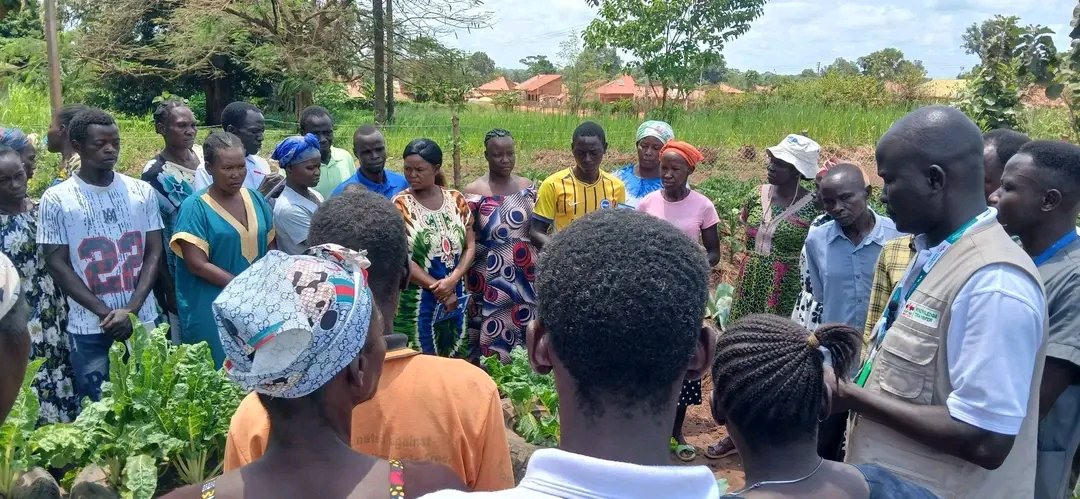
More than 500 farmers from communities across Yambio County have taken part in a practical agricultural field day aimed at promoting modern farming techniques and increasing food production amid growing efforts to strengthen rural livelihoods and food security.
The one-day Farmer Field Day brought together farmers from Bakiwiri, Bazungua, Bazumburu, Bawaa, Masumbu and surrounding communities, giving participants an opportunity to observe and learn practical farming methods at a demonstration plot in Yambio.
The initiative, organized under the Community Driven Rural Development (CDRD) Project with support from development partners, is seeking to move farmers beyond traditional cultivation methods by exposing them to affordable technologies that can potentially increase crop yields.
Agricultural specialists involved in the programme say the adoption of improved farming practices could help farmers produce more food from available land while strengthening household incomes and reducing some of the challenges associated with low agricultural productivity.
Nelson Mandela Ezadin, a Field Agronomist with SNV Netherlands Development Organisation, said the field day provides farmers with an opportunity to see agricultural technologies in practice rather than relying solely on theoretical training.
“The field day gives farmers an opportunity to learn and adopt technologies that can improve production and livelihoods,” Ezadin said.
The training comes as agriculture remains a major source of livelihoods for communities in Western Equatoria, where many households depend on smallholder farming for food and income.
However, farmers often face challenges including limited access to improved farming knowledge, quality seeds, agricultural inputs and appropriate technologies, which can contribute to low productivity.
At the demonstration plot, farmers were introduced to techniques designed to make agricultural production more affordable and accessible using materials available within their communities.
Peter Ajak Ateny, an agronomist with East-West Seed Knowledge Transfer, demonstrated methods of producing healthy seedlings using locally available materials, including leaf pots and ordinary garden soil.
The approach is intended to show farmers that improved agricultural practices do not always require expensive infrastructure or equipment.
By learning how to raise stronger seedlings before transplanting them into fields, farmers can potentially improve crop establishment and reduce losses during the early stages of production.
The demonstration also exposed farmers to improved techniques for producing crops including tomatoes, cabbage and maize.
For farmers who traditionally depend heavily on manual and conventional cultivation methods, such practical demonstrations provide an opportunity to compare different approaches and determine which techniques can be adapted to their own farms.
Anthony Badoro, a farmer from Masumbu, said the field training introduced farmers to techniques they had not previously been familiar with.
He said the knowledge could help farmers improve the way they cultivate vegetables and staple crops while increasing production at household level.
The exposure to improved agricultural practices is particularly significant for smallholder farmers, who form the backbone of food production in many rural communities but often operate with limited financial resources.
Instead of relying solely on large-scale agricultural machinery or costly inputs, the field day emphasized methods that farmers can adapt using locally available resources.
The organizers say increasing farmers’ knowledge is critical to improving food availability and strengthening food security in Yambio County.
Higher agricultural production could provide households with more food while allowing farmers to sell surplus produce in local markets, generating income to meet other household needs.
Improved production of vegetables such as tomatoes and cabbage could also increase the availability of nutritious food in local communities, while maize remains an important staple crop for many households.
The initiative therefore goes beyond agricultural training, linking farming knowledge to broader concerns about food security, household income and rural economic development.
For Western Equatoria, where large sections of the population depend on agriculture, improving productivity could also reduce dependence on food brought in from outside the state and strengthen local markets.
The major test for the initiative, however, will be whether farmers can translate the lessons from the demonstration plot into sustained changes on their own farms.
Agricultural experts say continued extension services, access to quality seeds, markets, financing and other agricultural inputs will be important if farmers are to adopt and maintain improved practices.
Training alone may not be enough if farmers are unable to obtain the materials or support required to apply what they have learned.
The CDRD-supported field day nevertheless provides a platform for connecting farmers with agronomists and development actors while creating opportunities for practical knowledge-sharing between communities.
With more than 500 farmers participating, organizers hope the knowledge gained can spread beyond the individuals who attended the event as participants share new practices with other farmers in their respective communities.
The initiative comes at a time when improving local agricultural production is increasingly seen as essential to strengthening household resilience and creating economic opportunities in rural areas.
For farmers, higher yields can mean more food for their families, greater income from the sale of surplus crops and increased capacity to invest in future agricultural seasons.
For communities, stronger agricultural production can stimulate local trade by increasing the movement of seeds, produce, transport and other services connected to farming.
The Farmer Field Day therefore represents an attempt to connect agricultural knowledge with practical improvements in food production and rural livelihoods.
As farmers return to their communities, the success of the initiative will ultimately depend on how widely the demonstrated practices are adopted and whether farmers receive continued technical and material support.
For Yambio’s farming communities, the message from the demonstration plot is increasingly clear: better farming knowledge, combined with affordable technologies and sustained support, could provide a pathway toward higher food production, stronger household incomes and greater food security across the county.


