
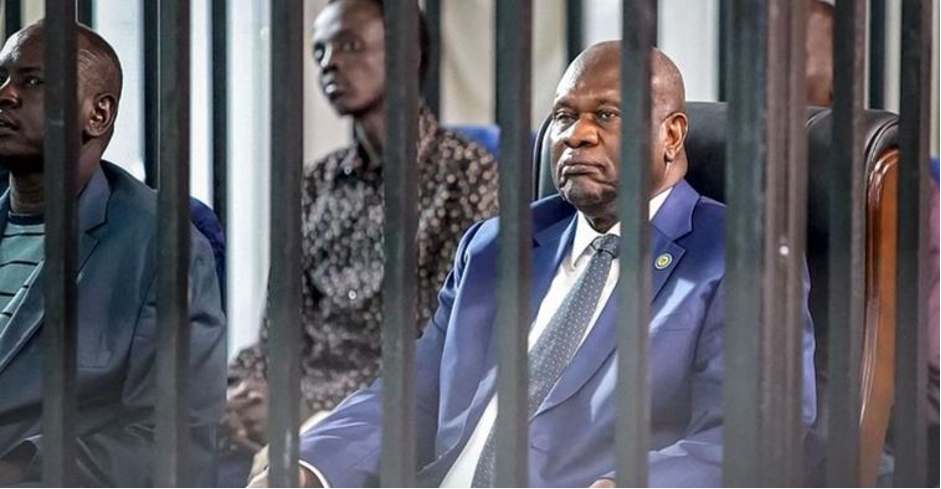
Prosecutors at South Sudan’s Special Court in Juba have rejected claims that their latest application is aimed at singling out suspended First Vice President Dr. Riek Machar.
The team insisted that they are seeking a uniform application of the law to all remaining defendants in the ongoing trial.
The prosecution’s position emerged Friday during the 113th proceeding at Freedom Hall, where lead prosecutor Ajo Ony’Ohisa responded to objections from the defence over a counter-application concerning the procedure for examining the accused.
Machar is the fifth accused in the case and is standing trial alongside seven other defendants over violence in Nasir, Upper Nile State, in March 2025.
The defence, led by Dr. Geri Raimondo Legge, acknowledged receiving the prosecution’s counter-application but objected to the prosecution’s use of a rejoinder, describing it as misleading.
The prosecution, however, argued that its application had been misunderstood.
“The Prosecution does not seek to invalidate or reopen the examinations already completed. Neither does it seek to single out the Fifth Accused for different treatment,” Ony’Ohisa told the court.
“It asks the Court to clarify and apply the correct statutory procedure prospectively and equally to all the remaining Accused Persons.”
The disagreement centres on provisions governing the court’s examination of accused persons during a criminal trial.
Ony’Ohisa referred to Section 197(1), which gives the court authority to question an accused at any stage of proceedings about circumstances appearing in the evidence against them.
The provision states:
“For the purpose of enabling the accused to explain any circumstances appearing in the evidence against him or her, the Court may at any stage of a trial, without a previous warning to the accused, put such questions to him or her as the Court considers necessary.”
The prosecutor also relied on Section 224(2)(e), which requires the court to question the accused generally on the case after prosecution witnesses have been examined and before the accused is called upon to present a defence.
According to the prosecution, the two provisions should be read together as establishing a court-controlled process designed to give each accused person an opportunity to respond to material circumstances arising from the evidence.
The prosecution said it was not asking the court to undo examinations that had already taken place. Instead, it wants the court to apply what it considers the correct procedure to defendants who have not yet reached that stage.
Ony’Ohisa also rejected the defence argument that such an approach could result in unequal treatment.
“The relevant equality is equality under the law, not equality in the repetition of an error,” he said.
The prosecution urged the court to reject what it described as the defence’s “erroneous interpretation” of its counter-application and to direct that the remaining defendants be examined prospectively in accordance with Sections 197(1) and 224(2)(e).
It further asked the court to issue any other orders it considers just and appropriate.
Judge Stephen Simon adjourned the proceedings until Monday, September 7, when the court is expected to rule on both the defence application seeking clarification of the defendants’ constitutional right to legal representation and the prosecution’s counter-application.
The procedural dispute is unfolding against the backdrop of one of South Sudan’s most politically sensitive trials.
Machar and the seven other defendants face charges including treason, murder, conspiracy, terrorism, destruction of public property and crimes against humanity.
The charges arise from violence in Nasir in March 2025, when government forces suffered heavy casualties during an attack on a military garrison.
Prosecutors allege that forces aligned with Machar’s Sudan People’s Liberation Army in Opposition, or SPLA-IO, together with the White Army militia, were responsible for the attack.
The prosecution alleges that 257 South Sudan People’s Defence Forces soldiers were killed, including military commander General David Majur Dak.
It has also alleged that military equipment valued at approximately $58 million was destroyed or seized during the fighting.
The defence has challenged the prosecution’s case, while the court continues to determine a number of legal and procedural questions before the trial moves further.
For the prosecution, Friday’s argument was ultimately about consistency: ensuring that the same statutory framework applies to those still awaiting examination.
For the defence, however, the manner in which those provisions are applied remains tied to broader questions about the constitutional rights of the accused.
The court’s ruling on September 7 could therefore have implications beyond the immediate procedural dispute, potentially shaping how the remaining stages of the trial are conducted.