
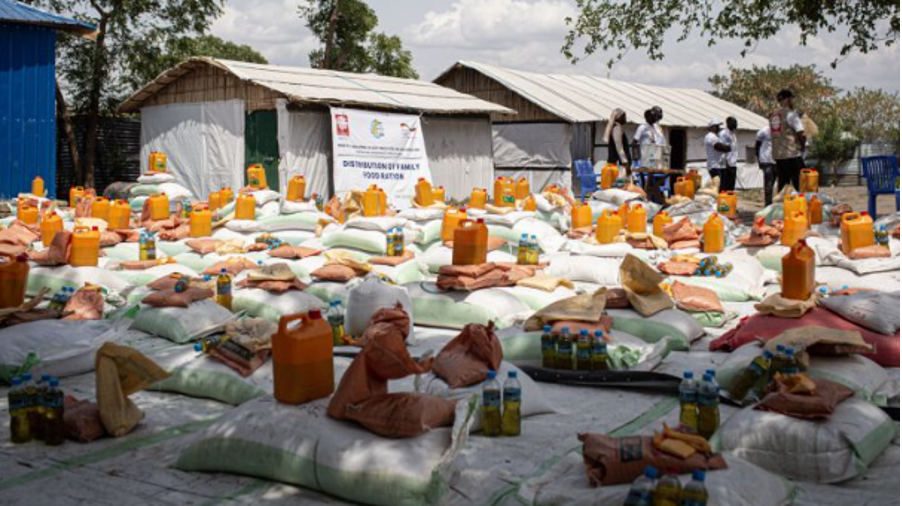
The Northern Bahr el Ghazal State Relief and Rehabilitation Commission (RRC) has warned residents against selling humanitarian supplies meant for vulnerable communities, saying anyone found involved will be held accountable.
RRC Acting Chairperson Gabiel Bol Dut said the commission issued the warning following reports that some beneficiaries were selling humanitarian commodities, including Plumpy’Nut, a specialized nutritional product used to treat malnutrition among children, in local markets.
“We have realized that the food items being given to our local people are being sold in the market, and this is punishable,” Bol said.
He appealed to parents and caregivers to ensure that nutritional supplies reach the children for whom they are intended instead of being sold.
“Items like Plumpy’Nut, which is used to reduce malnutrition, are being sold. Why not give it to the malnourished child? Also, CSB flour can be cooked by a mother and eaten together with her child,” he said.
Bol said the RRC has introduced directives to curb the illegal sale and purchase of humanitarian commodities.
He warned that the measures apply not only to people selling the supplies but also to individuals who knowingly purchase them for resale.
“We have a constitution governing such sales of humanitarian items, and once you are found, you will be held accountable for it,” he warned.
NGOs warned over state approval
In a separate development, Bol said the commission has reviewed its directives governing the activities of humanitarian organizations operating in Northern Bahr el Ghazal State.
The acting chairperson expressed concern that some national and international non-governmental organizations conduct meetings, trainings and field activities without informing or involving the RRC.
“It has come to our attention that NGOs hold meetings without us knowing. Anyone conducting training or going to far-flung areas needs approval or a go-ahead from us,” Bol said.
He warned that organizations operating without the knowledge or approval of relevant state authorities could face consequences and may be required to explain their activities.
Bol also criticized some international NGOs for allegedly selecting project locations without consulting state authorities.
“Some NGOs just go directly and choose the areas of their choice without our knowledge. This is unbecoming,” he said. Concerns over unfinished projects
Bol further raised concerns about the implementation of donor-funded projects, alleging that some organizations have left infrastructure projects unfinished.
He cited schools and health facilities among projects that, according to him, were sometimes constructed only partially before work was abandoned.
“Some get donations from donors, and the way they implement the projects is unwelcome. Some build incomplete infrastructure like schools and health facilities and leave them halfway done. This is too weird,” he said.
South Sudan remains heavily dependent on international humanitarian and development partners for essential services, particularly amid economic challenges and humanitarian needs.
The RRC’s concerns highlight ongoing debates over coordination between humanitarian organizations and state authorities, as well as accountability in the use of donor-funded resources.
The commission says stronger oversight is needed to ensure humanitarian assistance reaches intended beneficiaries and that development projects are implemented according to identified community needs.