
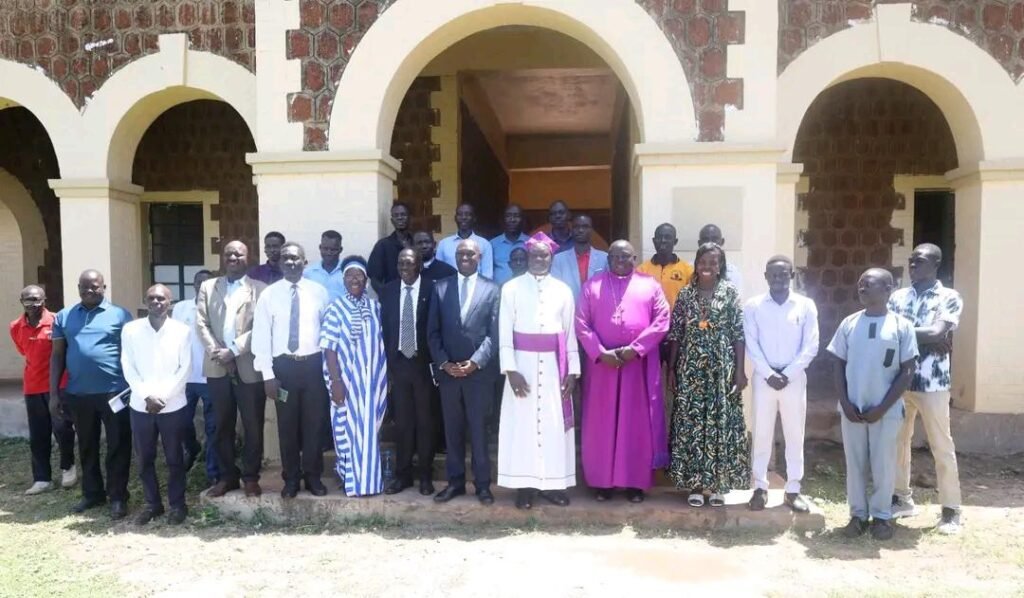
The Archbishop and Primate of the Episcopal Church of South Sudan, His Grace Dr. Justin Badi Arama, has challenged student-teachers at the Maridi National Teacher’s Training Institute (MNTTI) to view teaching not simply as a profession, but as a noble calling with the power to transform minds, build communities and shape the future of South Sudan.
Archbishop Badi made the remarks on Monday during a visit to the institute in Maridi, where he encouraged student-teachers to take their training seriously and prepare themselves for the wider responsibilities that come with becoming educators.
He said education goes beyond acquiring academic qualifications, describing training as a process that sharpens the mind and transforms students into intellectuals capable of making meaningful contributions to their communities.
“Education is about acquiring knowledge, and every training sharpens the mind and transforms a student into an intellectual,” Dr. Badi told the students.
The Archbishop urged the students not to underestimate the importance of the teaching profession, stressing that educators occupy a unique position in society because of their direct influence on the next generation.
He cautioned against attitudes that undermine professional or vocational training, saying those who dismiss opportunities to acquire skills risk missing an important path toward personal growth and service to society.
For Dr. Badi, becoming a teacher carries responsibilities that extend far beyond the classroom.
He said graduates of the institute would return to their communities not only as teachers, but as educated people expected to help shape the minds, values and aspirations of children and young people.
The message effectively placed teachers among the country’s key nation-builders, particularly in a society where education remains central to rebuilding communities and creating opportunities for younger generations.
The Archbishop further challenged the student-teachers to understand the influence they will have once they enter classrooms.
A teacher, he suggested, does more than deliver lessons. Teachers help children understand their communities, develop values, acquire knowledge and prepare for their future responsibilities as citizens.
This places educators in a position of leadership at the community level, where their influence can extend beyond school compounds.
“After graduation, you will be recognized as intellectuals in your communities,” was the central message of his remarks, as he encouraged the students to prepare themselves for the responsibility of influencing the next generation.
Dr. Badi also gave the profession a spiritual dimension by comparing the role of a teacher with the ministry of Jesus Christ.
He reminded the students that Jesus was referred to as “Rabbi,” meaning teacher, and said His example demonstrated the qualities expected from educators.
“Being a teacher is taking up the role of Jesus, who was called ‘Rabbi,’ meaning teacher. He taught with authority, compassion and truth, shaping people’s minds and hearts, which is exactly what is expected of teachers,” he said.
The comparison underscored the Archbishop’s call for teachers to approach their profession with integrity, compassion and a sense of responsibility rather than viewing it merely as a means of earning a living.
Viewing teachers as ambassadors of peace, Archbishop Badi called on the student-teachers to assume another important responsibility: promoting peace and reconciliation in South Sudan.
He commissioned them to become ambassadors of peace, reconciliation and unity at a time when the country continues to face challenges that require citizens and institutions to contribute to social cohesion.
For the Archbishop, classrooms can therefore become more than spaces for academic instruction. They can also serve as places where young South Sudanese learn tolerance, peaceful coexistence, respect and responsibility.
The call places teachers at the intersection of education and peacebuilding, giving them a potentially influential role in shaping how future generations understand conflict, reconciliation and national unity.
With Education and South Sudan’s future, Archbishop Badi’s message also comes at a time when South Sudan continues to face significant challenges in strengthening its education system and preparing enough qualified teachers to serve communities across the country.
Teacher-training institutions such as MNTTI are therefore critical to producing educators capable of supporting primary education and influencing the development of children at an early stage.
The Archbishop’s emphasis on intellectual development and nation-building suggests that teacher education should not stop at classroom techniques. It should also prepare teachers to become responsible community leaders and advocates for peaceful coexistence.
During his visit, Dr. Badi described his presence at the institute as a normal visit by a “son of Maridi” to appreciate the progress being made at the institution.
He commended the leadership of Principal Ustaz Jackson Ramadan and the institute’s tutors for their efforts in advancing the institution.
The Maridi National Teacher’s Training Institute has been undertaking reforms aimed at strengthening teacher preparation, particularly for primary schools.
The Archbishop assured the students and administration of the Church’s continued support through prayers as they pursue what he described as their noble calling to educate the nation.
For the student-teachers, the Archbishop’s message presented graduation not as the end of their journey, but as the beginning of a much larger responsibility.
Their future role, according to his message, will involve teaching children, shaping communities, promoting peace and contributing to the rebuilding of South Sudan.
The challenge is therefore not simply to become teachers, but to become educators capable of influencing the character and direction of the next generation.
As South Sudan looks toward its future, Dr. Badi’s message places teachers at the centre of that journey: educating minds, building communities and nurturing a generation capable of choosing peace over conflict and unity over division.