


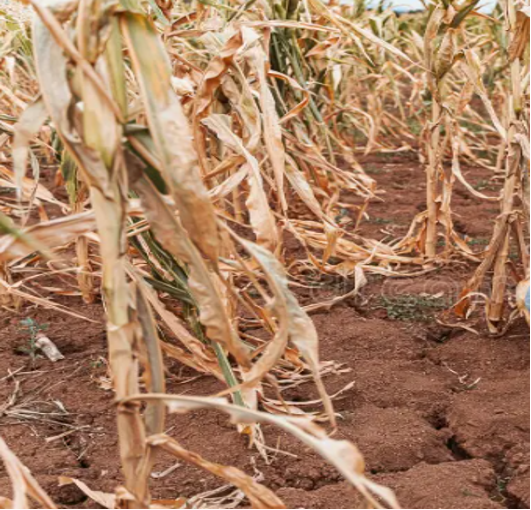
Farmers in Aweil East County are appealing for urgent assistance as prolonged dry conditions threaten crops, livestock and household food supplies in several communities.
Residents of Malual-baai Payam say unreliable rainfall has left crops drying in the fields, raising fears that poor harvests could worsen food shortages in the months ahead.
Executive Chief Yel Yel Kuol said the prospects for a meaningful harvest had become increasingly uncertain after rainfall declined sharply.
He called on the state government and humanitarian organizations to invest in water infrastructure and agricultural support, particularly the construction of large water ponds, commonly known as haffirs.
Kuol said such facilities could allow communities to grow vegetables and maintain food production during extended dry spells.
“I would suggest that the government engages the partners so that they dig the haffirs for us so that we can raise vegetables.”
Crops withering as rain fails
According to Kuol, communities in Rum-wel and neighboring areas, including Majak-Paluiel, Tiit-Ubiet and Warapac, are among those experiencing serious water shortages.
He said heavy rainfall stopped in May, followed by increasingly irregular precipitation that left farmers unable to maintain their crops.
The chief warned that the situation could become more severe if the dry conditions persist.
“There is little we can do because most of the areas I have mentioned are severely affected by the lack of rain, and crops are withering and drying up,” he said.
Livestock also under pressure
The shortage of rain is affecting more than crop production.
Kuol said several water ponds have already dried up, while pasture and other vegetation needed by livestock are becoming increasingly difficult to find.
He warned that continued depletion of water sources could expose livestock to greater risks and further undermine rural livelihoods.
For farming communities that depend heavily on both crops and animals, the combination of failed harvests, shrinking pasture and limited water could have serious consequences for household food security.
Government acknowledges drought
Authorities in Northern Bahr el Ghazal State say the problem extends beyond Aweil East.
Santino Bol Akot, Director General in the state Ministry of Agriculture and Forestry, said the government was aware of crop losses associated with extreme weather conditions in several parts of the state.
He identified Aweil East, Aweil North and Aweil South among the areas affected.
“We are fully aware of what is happening in most areas in the state, which are negatively impacted by drought,” Akot said.
The agriculture ministry plans to meet humanitarian and development organizations to discuss possible assistance for communities facing the effects of the dry conditions.
“We will call for a meeting with partners to devise ways to deliver any humanitarian support to them,” Akot said.
Call for longer-term solutions
Beyond emergency relief, the agriculture official encouraged communities to pursue activities that could strengthen their ability to withstand recurring climate shocks.
That includes supporting farmers with more sustainable ways to produce food and generate income despite changing weather patterns.
Authorities have also continued to warn against indiscriminate tree cutting, saying the loss of vegetation can damage wildlife habitats and increase environmental vulnerability.
For farmers in Aweil East, however, the priority is immediate: keeping crops alive, finding water for livestock and protecting household food supplies while they wait for government and humanitarian assistance.


