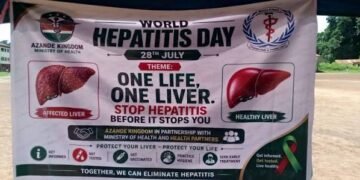



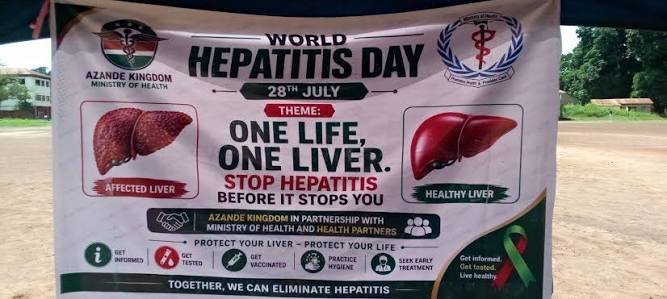
Health authorities in the Azande Kingdom have detected 783 hepatitis-positive cases among 10,800 people screened in an ongoing community health campaign, prompting calls for stronger testing, vaccination and treatment services.
The campaign, which started last year and is continuing, is aimed at increasing public awareness, expanding access to hepatitis screening and ensuring people who test positive are connected to medical care.
According to Siro David Peter, Minister of Health in the Azande Kingdom, the screening covered 4,900 men, 5,600 women and 300 children.
Women recorded the highest number of positive results, with 413 cases, followed by 305 men and 65 children.
The figures mean that about 7.3 percent of all people screened tested positive, although the screening results alone do not determine the type or severity of hepatitis infection.
Minister Siro said the campaign has helped bring hepatitis screening closer to communities, but warned that serious shortages of medical supplies and laboratory equipment are limiting the health sector’s ability to respond.
“Our biggest challenge is the shortage of testing kits and vaccines. We also do not have a viral-load machine or adequate capacity for liver-function testing, yet these services are important for properly monitoring patients,” Siro told The NIle Witness.
The minister said the shortage of testing kits could limit the number of people who can be reached, while inadequate vaccine supplies could undermine prevention efforts.
The health sector also lacks a viral-load testing machine and has limited capacity for liver-function tests, making it more difficult to monitor some patients and assess complications associated with liver disease.
Despite the challenges, the campaign has also recorded progress in prevention.
Health authorities say 3,000 people have received hepatitis vaccination during the campaign.
The vaccination effort is particularly important in preventing hepatitis B, which can become a chronic infection and cause serious liver complications if left untreated.
The campaign is also providing an opportunity to identify people who may have been living with the infection without knowing their status.
The campaign report indicates that 150 people with active viral infections are currently receiving treatment and require continued monitoring and follow-up.
Minister Siro stressed that identifying positive cases must be followed by sustained treatment and clinical monitoring.
“We need more support to expand testing, vaccination and treatment. Identifying people is only the first step; we must also have the capacity to monitor and treat those who test positive,” he said.
Health officials are concerned that the 783 positive results could represent only part of the actual burden because people in communities with limited access to testing may remain undiagnosed.
Viral hepatitis can remain unnoticed for years because many infected people may have few or no symptoms until serious liver damage develops.
Expanding community screening is therefore considered essential for identifying infections earlier and linking patients to appropriate care.
The World Health Organization has identified viral hepatitis as a significant public-health challenge in South Sudan, with hepatitis B and C contributing to long-term liver disease, including cirrhosis and liver cancer.
For the Azande Kingdom, health authorities say strengthening awareness, vaccination, testing and treatment will be critical to reducing the impact of the disease.
Minister Siro said the screening campaign will continue as health authorities work to reach more communities and connect people diagnosed with hepatitis to treatment and follow-up services.
He appealed for increased support to address shortages of testing kits, vaccines and laboratory equipment.
The minister’s warning comes as health authorities attempt to move beyond simply identifying hepatitis cases toward building a stronger system capable of prevention, diagnosis, treatment and long-term monitoring.
With 783 positive results already recorded from 10,800 screenings, the campaign has provided an important indication of the health challenge facing communities—but officials say the bigger concern is how many infections may remain undetected without expanded access to testing.
Key figures: 10,800 screened | 783 positive | 3,000 vaccinated | 150 active cases on treatment | 413 female positive cases | 305 male positive cases | 65 children positive.


