
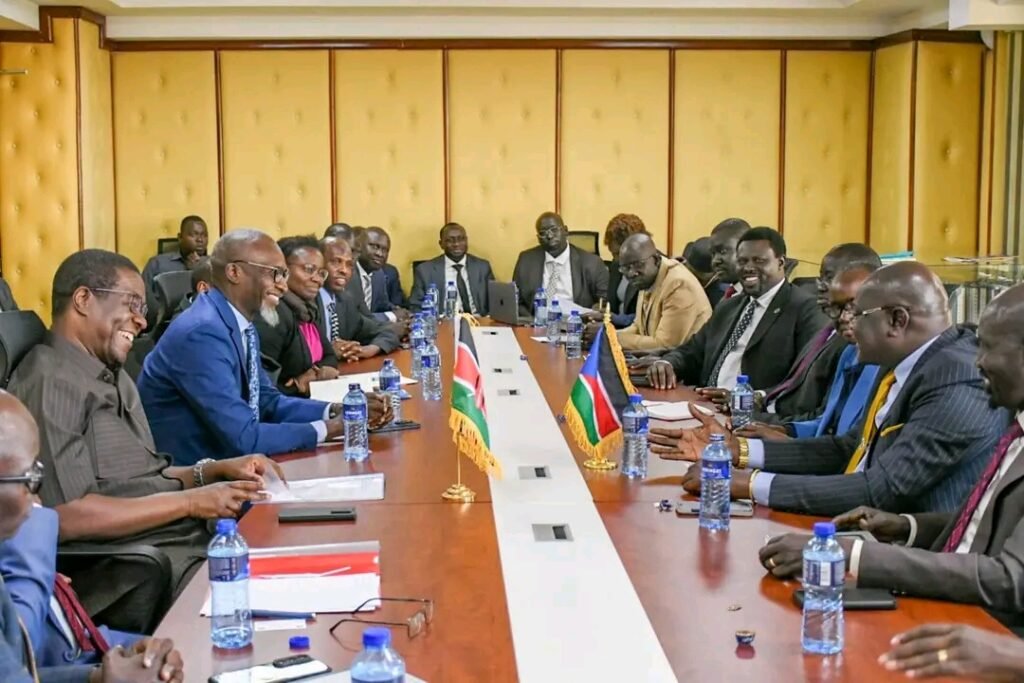
South Sudan’s economic reform drive is set for further review after the government’s Committee for Economic Reforms returned from a mission to Nairobi, with officials expected to present a detailed report on the outcome of the trip to the Council of Ministers.
The committee briefed the Governance Cluster on its Nairobi mission during a recent meeting chaired by Vice President Rebecca Nyandeng de Mabior. The cluster said it was satisfied with the initial briefing but requested a more comprehensive report before the findings are presented to the Council of Ministers for consideration.
The mission comes as South Sudan faces persistent economic pressures, including limited non-oil revenues, heavy dependence on oil, weak public financial management and the need to strengthen domestic revenue collection.
Minister of Cabinet Affairs Dr. Martin Elia Lomuro said the committee had provided a preliminary account of its mission, but that a detailed report would be required before the government could assess its recommendations.
“We also heard a brief report from the Committee for Economic Reform, which gave us a very brief report on their mission to Nairobi, and we were satisfied with the brief report pending a detailed report which will be submitted to us for the Council of Ministers,” Lomuro said.
The committee’s visit to Kenya comes at a critical time for South Sudan’s economy, which remains highly dependent on oil revenues while facing significant demands for public expenditure.
Economic reforms have increasingly focused on strengthening domestic revenue mobilisation, improving financial management, expanding the tax base and reducing leakages in government revenue collection.
The government has also been exploring measures aimed at improving the collection and management of non-oil revenues as it seeks to finance public services and meet its obligations, including salaries and essential government operations.
A detailed report from the Nairobi mission could therefore provide the government with recommendations on reforms that may be applicable to South Sudan’s economic and revenue-management systems.
The Governance Cluster did not immediately disclose the specific issues discussed in Nairobi or the recommendations contained in the preliminary briefing.
The decision to await a detailed report means the committee’s findings are yet to become formal government policy.
Once submitted, the report is expected to allow the Council of Ministers to examine the committee’s recommendations and determine which measures can be adopted within South Sudan’s economic and institutional context.
The process also highlights the government’s growing reliance on technical consultations and regional experiences as it searches for ways to strengthen economic governance.
For South Sudan, increasing domestic revenue is particularly important because government finances have historically depended heavily on oil exports.
Fluctuations in oil production, disruptions to oil infrastructure and wider economic pressures can therefore have a direct impact on government revenues.
Strengthening non-oil revenue collection could give the government a more predictable source of financing while reducing vulnerability to changes in the oil sector.
Recent government discussions have included tax reform, customs administration, fuel monitoring, weighbridges and other mechanisms intended to improve revenue mobilisation and regulatory oversight.
Economic reform experts and civil society groups have repeatedly emphasized that improved revenue collection must ultimately benefit citizens through better public services and stronger accountability.
For ordinary South Sudanese, the success of economic reforms is likely to be measured not only by government revenue figures but also by whether reforms improve the payment of salaries, strengthen health and education services, rehabilitate roads and reduce the financial burden on households.
The government therefore faces the challenge of ensuring that reforms are accompanied by greater transparency in public spending and effective oversight of collected revenues.
The forthcoming detailed report will provide an opportunity for the Council of Ministers to assess the lessons and recommendations from the Nairobi mission and determine their relevance to South Sudan.
The government has not announced when the full report will be presented.
However, the decision to take the matter to the Council of Ministers indicates that the Nairobi mission forms part of broader efforts to strengthen economic governance at a time when South Sudan is seeking to improve domestic revenue mobilisation and reduce its dependence on external support.
As the country prepares for major political and economic decisions, attention will now turn to whether the recommendations emerging from Nairobi can be converted into practical reforms capable of strengthening South Sudan’s economy, improving government revenue and delivering tangible benefits to citizens.