



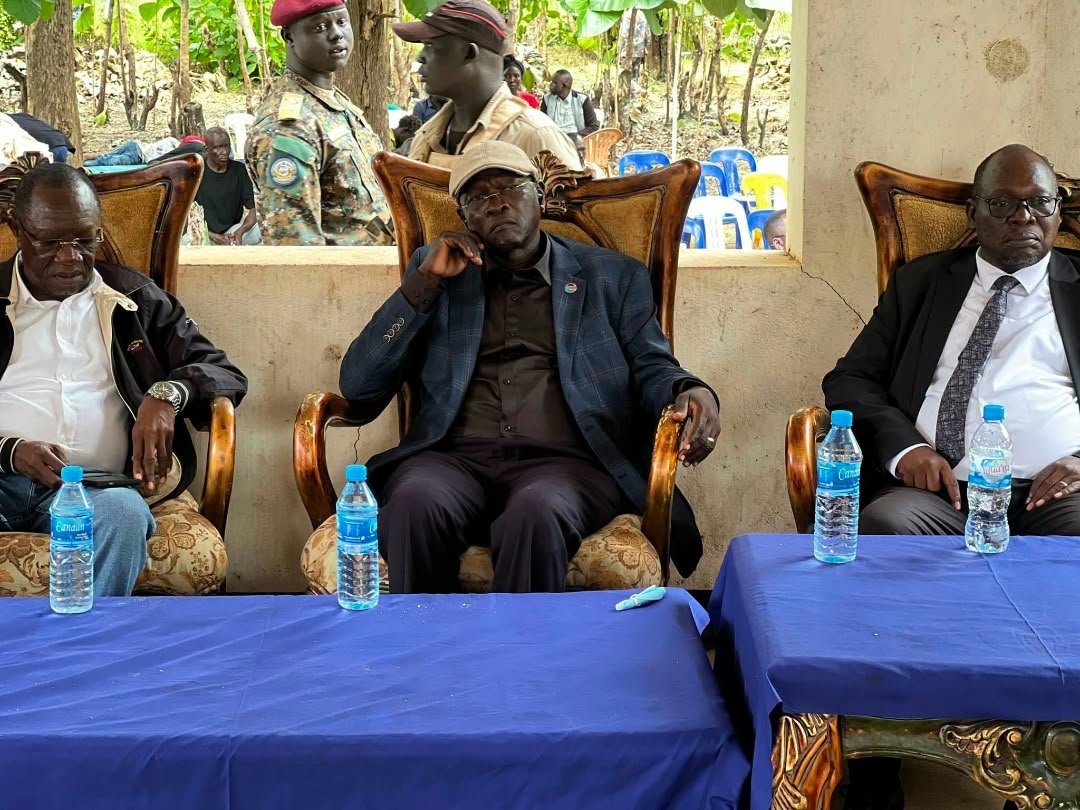
South Sudan’s Transitional National Legislative Assembly Speaker, Rt. Hon. Joseph Ngere Päciko, has warned that continued road ambushes in Mundri East County are undermining major infrastructure projects and could further delay the construction of a key highway connecting communities across Western Equatoria.
Päciko said insecurity had contributed to the disruption of the Juba–Mundri–Maridi–Yambio–Tambura road project, which was launched by President Salva Kiir Mayardit in 2023 as part of efforts to improve connectivity and stimulate economic activity in the region.
Speaking in Lui Payam after the burial of the late Hon. Kosti Manibe Ngai, the Speaker said attacks targeting travellers and road workers had created conditions in which contractors and engineers could not safely continue their work.
“We spoiled it by ambushing and killing innocent people, including engineers assigned to African Resource Company. There will be no work on the road unless there is peace and an end to road ambushes,” Päciko said.
The warning places insecurity at the centre of concerns over the progress of one of Western Equatoria’s major infrastructure projects.
The Juba–Mundri–Maridi–Yambio–Tombura corridor is expected to improve movement between communities, facilitate trade and strengthen connections between Western Equatoria and other parts of South Sudan.
However, construction of major roads requires contractors, engineers, equipment and materials to move safely through project areas.
Päciko said attacks have undermined these conditions, threatening the continuity of road construction.
The Speaker specifically referred to the killing of engineers working with African Resource Company (ARC), saying the attacks had contributed to the disruption of road works.
The loss of technical personnel can create additional challenges for infrastructure projects, particularly where specialized skills are required to supervise construction and engineering activities.
The Speaker’s comments suggest that restoring security is now critical if contractors are to return and road works are to resume fully.
Päciko linked the security situation directly to the broader development needs of Western Equatoria.
He said communities cannot expect major infrastructure investments to continue if roads remain unsafe for workers and travellers.
The Speaker urged young people and community leaders to reject violence and work toward creating an environment where government and development projects can operate safely.
“There will be no work on the road unless there is peace and an end to road ambushes,” he emphasized.
The statement places responsibility on local communities and security authorities to help create the conditions necessary for infrastructure development.
Delays to the road project could have consequences beyond construction itself.
Improved roads are expected to reduce transport difficulties, facilitate movement of agricultural produce, connect markets and improve access to essential services.
Western Equatoria is heavily dependent on agriculture, meaning better road connectivity could help farmers transport crops to markets and reduce some of the difficulties associated with poor transport infrastructure.
A prolonged interruption could therefore delay the wider economic benefits expected from the project.
Youth urged to choose development
The Speaker also appealed to young people in Mundri East to abandon armed violence and instead contribute to peace and development.
He said continued insecurity was damaging the reputation of the county while denying communities the benefits that infrastructure and economic investment could bring.
The Speaker returned to Juba with fellow government officials following the funeral.
His remarks have placed renewed attention on the relationship between security and infrastructure development, with the progress of major road projects increasingly dependent on whether communities and authorities can establish a safer operating environment.
For Western Equatoria, the challenge is no longer simply building roads. It is creating the peace and security necessary to ensure that the roads can actually be built, used safely and deliver the economic benefits promised to local communities.


